My Adventure Through Our Family Tree Branches

For over 50 years my Dad researched both his and my Mom's family tree branches - and loved every minute of it! Trying to fulfill the promise I made him the last month of his life, I have spent the past four years continuing where he left off - finding out about all the many family members who came before us, from the many branches of our family trees. The histories will still be published as my Dad always wanted. But what he wanted most was to share the stories of the people who came before us - the places they lived, the cultures of the times, the families they created, and the circumstances - good and bad - that would one day lead to us, their descendants. These are the stories of my Mom's families. . . .

Surnames in this Blog

BRUNETT, DeGRUY, DeLERY, FLEMMING, FORTIER, FRISSE, HORST, HUBER, JACKSON, McCAFFREY, McCLUSKEY, O'DONNELL, WEINSCHENK


Showing posts with label Weinschenk. Show all posts

Thursday, July 4, 2013

THURSDAY'S TREASURES - Life, Liberty and the Pursuit of Happiness

On this, the 237th birthday of the United States of America, it seems the perfect time to celebrate not only our country's birth but also the gifts that were passed down to us from our ancestors who made it possible for us to celebrate as Americans.

Irish Immigrants Leaving Queenstown Harbour
The Illustrated London News, September 1874

For each of us there were great-grandfathers and great-grandmothers who left their homeland, their neighbors, the culture and very often their own families to take a chance in this new country of which they knew very little. They gathered up all they could carry with them, said good-bye to their friends and families, and left the only home they had ever known and most likely one they would never return to. They travelled by cart or by foot to a sea port where they would board a small packet ship. Once aboard they would climb down into the hull of the vessel with one hundred, two hundred, or more strangers to travel for several weeks across the Atlantic Ocean. With all of the multitude of people stuffed into the ship's steerage area [see post "Packet Ship Gladiator", January 1, 2012,  for more information about steerage] they all shared one common dream - a better life in America.

Many left behind poverty, with little chance to ever change their circumstances. Most left countries with governments that held a tight rein on their individual rights and freedoms. Towns where they weren't allowed to speak, or protest, or gather freely. Where they couldn't vote to choose their own leaders. Where their children faced forced conscription into the military. Where the right to practice the religion of their own choosing didn't exist.


"Irish Immigrants Leaving Home"
Harper's Bazaar, December 1870
They each knew that a better life existed - for themselves and for their children. And for their children's children. They wanted more for their life and for their family. They wanted to be free to choose their own path in life, and be treated as human beings with God-given rights. They wanted to work hard and be rewarded with just compensation. They wanted to have a say in their government and in the laws they lived under. They wanted to freely practice their faith. They wanted the freedom to have a dissenting opinion about their leaders, share it openly, without the fear of reprisals. They wanted this for themselves. But most of all they wanted this for their children.

"From the Old to the New World"
German Emigration
Harper's Weekly, November 1874
They left everything behind for a promise of a better life. They sailed on a ship across a wide ocean, not knowing if they or their family members would survive, or if the ship itself would make it safely. They landed in a port where they couldn't speak the language, maybe had no one waiting for them, had little direction on where to go or what to do next. But they paved the way for each one of their children, each one of their grandchildren - each one of us - to enjoy those unalienable rights we each possess, endowed for us by our Creator.

Among these - Life, Liberty and the Pursuit of Happiness.

America wasn't perfect then and it isn't perfect now. But it's the best there is. And we have our ancestors to thank for giving us the opportunity for a better future. So it's nice today to remember those that made it possible:

Patrick McCloskey (1810-1855) who arrived in Philadelphia, Pennsylvania in 1838, at the age of 28, from his home in Ireland. His wife Mary Ann (1805-1871) also immigrated from Ireland, date unknown. They are my 4x great-grandparents.

Thomas McCaffrey (1799-1890), arrived in New York Harbor in June 1825 from his home in County Tyrone, Ireland. His wife Susan (1793-1869) also immigrated from County Tyrone, date unknown. They, too, are my 4x-great-grandparents.

Johann Eckard Horst (1802-1852), my 4x-great-grandfather, arrived in August 1846 in New York City Harbor at the age of 43 with his second wife and five children. This included my 3x-great-grandfather Martin Horst (1830-1878), who was just 16 years old when he arrived. Later my 5x-great-grandfather Johan Conrad Horst (1780-UNK), Martin's grandfather, also arrived here, in May 1860. He was 80 years old when he arrived. They were from Hesse-Darmstadt, Germany.
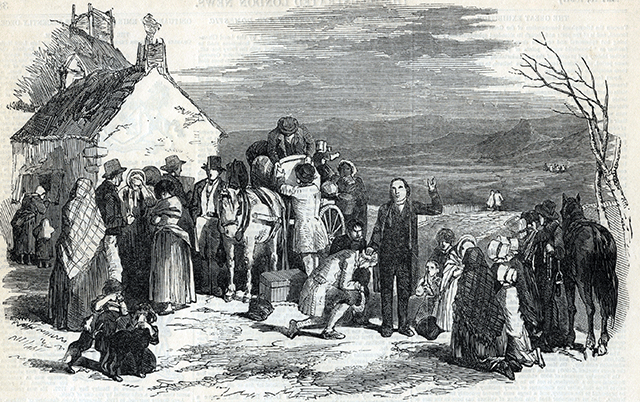
"Irish Emigrants Leaving Home - The Priest's Blessing"
The Illustrated London News, May 1851

Apollonia Weinschenk (1829-1908), my 3x-great-grandmother and wife of Martin Horst, arrived in the port of New Orleans around 1843, at the age of 14, from her home in Forst, Bavaria, Germany.

 My great-great-grandfather Patrick O'Donnell (1823-1911) arrived in this country in December 1849 from Ireland, along with five of his 7 brothers. He was 26 years old. His wife Bridget Kennedy (1838-1893) immigrated from her home in  County Tipperary, Ireland, sometime in the early 1850's.

Phillip Huber (1847-1901), also my great-great-grandfather, arrived in New York in June 1867, at the age of 19, from Florsheim, Hessen, Germany.

My 3x-great-grandparents, John Michael Baptiste Brunett (1818-1863), and Barbara Frisse (1822-1893) traveled onboard the same ship, from their homes in Seingbouse, Moselle, France, arriving in the port of New Orleans in July 1846. Traveling with Barbara were her parents (my 4x-great-grandparents) Joseph Frise (1796-1864) and Marguerite Lang (1802-1868), as well as several siblings. Marguerite was 44 years old; Joseph was 50.

[NOTE: My Fortier and DeGruey ancestors arrived from France to Canada and then settled in Louisiana before the United States was formed. I have no information yet as to when my Flemming or Jackson family ancestors arrived in America.]

"Immigrants Behold the Statue of Liberty"
Frank Leslie's Illustrated Newspaper, July 1887
None of these ancestors arrived as we might imagine - coming into New York Harbor and seeing the Statue of Liberty, stepping off their steamship onto Ellis Island to be officially inspected in long lines. [The Statue of Liberty wasn't dedicated until 1886.] None of these ancestors settled on the east coast - most made their new homes in southern cities. And somehow, through happenstance or through fate, their offspring met other offspring of these immigrants and eventually, over time and over years, my mother and her siblings were created from a combination of all of these immigrants. And that made it possible for me to sit down, in my home in Birmingham, Alabama, and celebrate Independence Day and my great-grandparents' dreams for a better life.

Sunday, April 21, 2013

SUNDAY'S OBITUARY - Jacob H. Fermier (1881-1932)


The Birmingham News; Feb. 5, 1932
Fall Proves Fatal
Jacob Fermier, Prominent in Mobile Carnival, Succumbs to Injuries
"Jacob H. Fermier, 45, engaged in the real estate business and prominent in the Infant Mystic, a Mardi gras carnival society, died at a hospital Thursday from injuries received in a fall down an elevator shaft Thursday night. Fermier was engaged in the work of sending out tickets to the annual ball of the society and went to the rear of the building and in the darkness stumbled into the elevator shaft which had been left open." [The Birmingham News; February 5, 1932]


Mobile Register, Feb. 5, 1932
Jacob Fermier Dies from Fall in Building Here
Mobile Real Estate Firm Employee Fatally Injured in Plunge Down Shaft
"Jacob H. Fermier, about 45 years of age, an employe (sic) of Hermann & Hynde real estate firm, died at City hospital early this morning from head injuries received when he fell one floor down an elevator shaft of a building on Exchange alley, located off Water, between St. Michael and St. Francis streets, used as headquarters for the Infant Mystics. The accident occurred about 7 o'clock Thursday night.
     Mr. Fermier, with three other members of the ticket committee of the society, was preparing tickets for their Mardi Gras dance Monday night. He left his duties to retire to the rear part of the headquarters.
     Other members of the committee, alerted when Mr. Fermier did not return within a reasonable time, began an investigation. Their attention was attracted by groans, and further investigation revealed Mr. Fermier lying on the concrete floor below at the foot of the shaft.
     He was taken to the hospital, where he died within a few hours." [Mobile Register; February 5, 1932]

Mobile Register, Feb. 6, 1932
Rites for Mr. Fermier
Mobilian Killed in Fall Thursday Night to be Buried Today
     "Funeral services for Jacob H. Fermier, lifelong resident of Mobile who died early yesterday morning from injuries in a fall down an elevator shaft in the Infant Mystic headquarters on Exchange alley, will be held at 9 o'clock this morning at Roche mortuary and at 9:30 o'clock at the Cathedral of the Immaculate Conception with mass. Internment will be in Magnolia cemetery.
     Mr. Fermier is survived by a sister, Mrs. B.J. Echenrode, (sic) of Emmitsburg, Md, an aunt, Mrs. R.A. Sands, of Mobile, an uncle, Victor Fermier, of Texas, and other relatives." [Mobile Register, February 6, 1932]


Jacob Henry Fermier was born August 11, 1881, in Mobile, Alabama. His parents were Jacob Fermier (1852-1889), a plumber and gas-fitter, originally from Bavaria, and Anna Berg (1851-1907). Anna, my great-great-great aunt, was the daughter of Tobias Berg (1819-1853) and Apollonia Weinschenk (1829-1908), both immigrants from Germany. Apollonia is my 3x-great-grandmother. [Tobias was her first husband with whom she had four children, including Anna; her second husband was Martin Horst (1830-1878), my 3x-great-grandfather, with whom she had 8 children including my great-great-grandfather Charles F. Horst.]

J. Fermier (ca. 1905)
from Erik Overby collection
University of South Alabama Collection
Young Jacob, known as 'Jack', was the oldest of the two children of Jacob and Anna. His younger sister, Annie, was born October 13, 1887. Jack and Annie lost their father when they were very young - Jack was just 8 years old, Annie was not yet two. To help support the family their mother opened her home to boarders, housing men, as many as 7-8 at their home at 209 Conti Street. Anna died in 1907 after suffering a stroke. [Annie J. Fermier, Jack's younger sister, married Bernard Eckenrode, a professor at Spring Hill College, in 1914 and moved with him to Emmitsburg, Maryland. Here they had one daughter, Anna Eckenrode (1918-2002). In 1937 Annie died at her home in Maryland; she was just 49 at the time of her death.]

Jack never married. He was employed with Hermann & Hynde Real Estate in Mobile. He also was involved in the Infant Mystics. The Infant Mystics is the second oldest of the numerous mystic societies that celebrate Mardi Gras each year in Mobile (much like krewes in New Orleans). The Infant Mystics dates back to 1868, at which time they held their parade on Mardi Gras (fat Tuesday) night. They have since changed the date of their parade to Mundi Gras (fat Monday).

Original emblem of Infant Mystics
Membership in the mystic societies is secret. Each year during Carnival Season, the mystic societies parade in costumes on their individual floats through downtown Mobile, tossing small gifts to spectators along the parade route. Each society also holds its own masquerade ball each year. These balls are almost always by invitation only, and attendees must abide by the strict dress code - usually elegant evening gowns for ladies and white-tie and tails for men. The ball usually continues the theme of the year, which is also depicted on their floats.


Jack was buried with his mother and father at Magnolia Cemetery in Mobile. It's interesting to note that the newspaper gives his age as 45. He was actually 50 years old at the time of his death.
Grave of Fermier Family
Magnolia Cemetery, Mobile, Alabama

Friday, December 23, 2011

THURSDAY'S TREASURE - Turn-of-the-Century Christmas in the Horst Home, Mobile, Alabama

Vintage Christmas Postcard  ca. 1900

In my father's family research folders there are thousands of pages of notes, copies of records, letters from family and replies from officials. So it was a wonderful surprise to find a typewritten letter from Regina Lane (1893-1979), my first cousin, 3x removed. She had typed out a nine page "Horst Family Tree", writing as many names, dates and stories as she knew. On a page in the middle of the history is a story she titled "A Little Christmas Fable."

Mary Regina Altice was the oldest of three children born to Emma Elizabeth Horst (1865-1923) and Charles Monroe Altice (1864-1943). Her mother, Emma, was the the fifth of eight children born to Martin Horst (1830-1878) and Apollonia Weinschenk (1829-1908), my great-great-great-grandparents. [My great-great-grandfather was Charles Frederick Horst (1856-1912), Emma's older brother and Regina's uncle.]

Ladies Home Journal
December 1898
Regina married late in life, at age 43. On April 14, 1937, in Mobile, Alabama, she married Maurice Joseph Lane, an insurance man born in Boston, Massachusetts. He was 51 when they married. Regina and Maurice had a 3-month long honeymoon in Europe and lived in Newton, Massachusetts when they returned, a suburb of Boston. Their life together lasted only five short years; Maurice died November 1942. Regina moved back to her hometown of Mobile after his death. In her remaining years she became very involved in service to her church, St. Joseph's Catholic Church, as well as to the community. She was recognized by Pope Pius XII for her service when he awarded her the Pro-Ecclesia-et-Pontificise medal, the highest award that can be bestowed by the Pope to a non-clergy member. Regina died on June 17, 1979, at the age of 85.

In her story, Regina recounts what Christmas was like at her grandmother's home at the end of the 19th, beginning of the 20th century. Her grandparents were both immigrants from Germany, the culture that introduced Christmas trees to the American Christmas celebrations. Regina's grandfather had died fifteen years before she was born, but her grandmother along with her aunt Apollonia "Appie" (1870-1942) and cousin Apollonia Manson (1894-1972) still lived in the family home Martin Horst had built after the Civil War.

Here is her story. . .

A Christmas Fable
"Christmas Eve was a most thrilling and exciting time in the Horst family life. Grandma's beautiful mansion was gay with happy grandchildren. Twenty-three she had, of course some lived in Toronto, Canada, and some in Birmingham, who wouldn't be here for the festivities.
Liberty Head Half Eagle
$5.00 Gold Coin (1839-1908)
Each Christmas time Grandma bought the largest Christmas tree she could find. It always reached to the high ceiling and was decorated in garlands of cranberries, strung on long cords, and garlands of pop corn, and many, many exquisite colored glass ornaments and balls, and tiny candle holders, holding small red candles snapped on the branch ends, and all lighted, till we stood, awe struck at the glowing sight. At about dark the door bell rang, and there was Santa Claus tinkling a bell. He was our Aunt Anna and we never even dreamed it, for we all thought he was straight from the North Pole.

Liberty Head Quarter Eagle
$2.50 Gold Coin (1840-1907)
He came into the parlor and shook each one's hand and gave use each an envelope, with a gold $2.50 piece in it. My sister Zoe always got a $5.00 gold piece in hers because Grandma loved her very much. Then we all received stockings stuffed with oranges, apples, nuts, and small gifts. All the older members of the party had wine and fruit-cake, while we had our goodies of a different kind. There was singing and the children danced, and a good time was had by all, then drowsy and tired we thanked our dear Grandma and a merry good-night was wished to all." 
Vintage Postcard ca.1908


Wednesday, September 7, 2011

WONDERFUL WEDNESDAY'S PHOTO - Four Generations of Horst Women, ca.1907

Four Generations of Horst Women
Mobile, Alabama ca. 1907

Four generations of Horst women make up this family photograph, including my great-grandmother and my great-great-great-grandmother. This photograph, made into a postcard, was taken about 1907 at Monroe Park, Mobile's most popular entertainment destination. [NOTE: the name of the park can be seen on the painting of the background.] Written on the back of the photograph are their names: "Aunt Dolly, Mama and Pearl, Aunt Appy and daughter Appolonia, Appolonia Horst".

Seated in the front center of the picture is the Horst family matriarch, Apollonia Weinschenk Horst (1829-1908), my great-great-great-Grandmother.Standing, from left, are two of Apollonia's granddaughters, Odalie Felice "Dolly" Horst (1896-1990) and Pearl Alphonsine Horst Flemming (1884-1961). Pearl is my great-Grandmother. Pearl and Dolly are the daughters of Apollonia's oldest son, Charles Frederick Horst (1856-1912) and Odalie Felice Fortier (1857-1920), my great-great-grandparents. Pearl and Dolly both lived in Birmingham and obviously were visiting their grandmother and other family in Mobile when this picture was taken.

Pearl is holding her oldest daughter, Pearl Alphonsine Flemming, who was born in Birmingham on March 11, 1907 - her father is my great-grandfather Harry Clinton Flemming (1878-1955). Baby Pearl was the first great-grandchild of Apollonia. She is also the older sister of my grandmother Susie Flemming O'Donnell (1909-1989).

Standing at Pearl's left is her aunt Apollonia "Appie" Horst Manson (1870-1942). Appie is the youngest child of Apollonia - Apollonia's husband and the father of Appie is Martin Horst (1830-1878). Next to Appie, on her left, is her only child, Marie Apollonia Manson (1894-1972). Appie's husband and her daughter's father, James Hunter Manson, died in 1896 when his daughter was just two years old. Appie and her daughter moved in with her mother and lived with her until the matriarch's death the year after this picture was taken. (In 1915, at the age of 45, Appie married Robert Sands (1860-1946), the son of a distinguished Civil War Captain.)

Monroe Park
Monroe Park was established in 1893 near Mobile Bay. It was located east of  Frascati Park, once owned and operated by the Horst family until it was destroyed by a hurricane in 1893. Monroe Park operated in Mobile until the 1940's. Here are two great vintage postcards showing scenes of Monroe Park in its heyday.

The back of this 1918 vintage postcard describes the park in this way:
"Monroe Park" on Mobile Bay is the largest pleasure park around Mobile. It has been the scene of many large gatherings. A large number of church, school and private picnics are given there during the season. Crowds gather nightly to see the free moving pictures, while enjoying the gulf breezes.
Another charming vintage postcard shows off the carousel at the center of the park.


Steam Carousel at Monroe Park, ca. 1908


Saturday, August 27, 2011

SATURDAY'S STRUCTURE - The Martin Horst House - Mobile, Alabama

Martin Horst House
407 Conti Street, Mobile, Alabama
Martin Horst (1830-1878), my 3rd great-Grandfather, commissioned George Woodward Cox to build his family home in Mobile, Alabama, in 1867. The house was built on the corner of Conti and Hamilton, at 407 Conti Street, for $26,000.

In a letter dated January 12, 1868, to his brother Charles (Carl) in Metropolis, Illinois, Martin wrote:
"I am just now finishing up my new dwelling I have been building which cost me twenty-six thousand dolls. Seven thousand more than I calculated on, and when I began last Spring I had only twelve Thousand Cash hoping at that time to collect by Jan. 1st at least six or seven Thousand dolls. that I could draw out of my business but so far I have not been able to collect one dolls. of this money and probable never will; as most people who owe any money are taking the benefit of the Bankrupt Law and than them is a very poor showing. At present I am paying one or two per. pr. for money I had to borrow as I could not collect what is due me four & five months ago. People are very indifferent about it whether they pay you or not the only Satisfaction they give you is; wait until I have some money then I will pay you. This are trying times down here. No money and no Business and none in Prospect. But had I known Six months ago that such time was in Store for us I would have kept my twelve Thousand dolls. in hand and could buy this day a house for it equally as good as the one I have paid 26,000. Nobody knew such things would come to pass. Houses do not bring the value of the Bricks this day, not one half of what they cost to build in 1860 or even two years ago. Such is the State of affairs all over the Southern States; and will remain so as long as radical Thiefs rule this once happy Country...."

Builder George Woodward Cox was born in London in 1814. An orphan, he was sent in 1828 by two sisters to live with his half-brother, William Cox, who was an established builder and contractor in Mobile. George Cox was an apprentice to his brother until William's death in 1832. In spite of this, Cox prospered; at the age of twenty-one he was a successful bidder for the United States Arsenal at Mount Vernon, near Mobile. He built other residences in the city. He died in Mobile in 1869.


from Historic American Building Survey
ca. 1971

Robert E. Lee bust in Parlor Archway
The house is a two-story, Italianate style home, L-shaped home, with a large courtyard and Carriage House. Wrought iron, original to the home, frames the front balcony and the fence surrounding the residence. The first floor of the home has a central hall, flanked by two rooms on the right, and a double parlor on the left. In the archway between the two parlors, Martin Horst had placed a bust in bas-relief of Robert E. Lee on one side, and Stonewall Jackson on the other. Upstairs there are two rooms on either side of the house. In the back of the home, in the service wing, there are two rooms separated by a stairwell on the first floor, and four rooms upstairs on the second floor. A large wine cellar is located below the service wing. Four fireplaces grace the first floor of the main house.

Front Gate of Home
Martin and his wife Apollonia (1829-1908) raised their six surviving children in the home, including my great-great-Grandfather Charles Frederick (1856-1912). They were well known for hosting impressive dinners, especially for their German friends, and celebrating holidays with their family in the home. Apollonia also supplied flowers from her garden to the Cathedral located nearby. Martin died in his home in October 1878. Apollonia continued living here, first with her adult children, later with their spouses. By the time of the 1900 U.S. Census, along with her young widowed daughter, Apollonia was taking in borders to help defray expenses. On April 24, 1908 Apollonia also died in her home, at the age of 80. Daughter Apollonia "Appie" Manson (1870-1942) continued living here, with her own young daughter Apollonia Manson (1894-1972) before remarrying and moving out. By 1920, the house was used only for borders - Jeanette Ellsworth, a 54-year single woman was the landlady, along with 20 borders from all over the country.


Bernard's Restaurant Menu

from Mobile Press-Register
July 11, 1965
[CLICK ON PICTURE TO ENLARGE]
In 1923 the house was sold to the Zougby family. Eventually the home came under extreme disrepair and it was set to be bulldozed in 1965 to make room for parking for the adjacent building. At this time the Mobile Historic Commission bought the building, then sold it in 1971 to Carl Brady, who agreed to restore and maintain it. During the mid-70's and 80's the building became Moongate Restaurant. Later the home became the site of Bernard's Restaurant, including outdoor dining in the courtyard.

The house has been called "The Martin Horst House," "The Horst-Zoughby House," "Moongate Restaurant" and "Bernard's Restaurant". It is now called The Ezell House, and is the site of weddings, receptions and parties. Their website has a "virtual tour" of the interior of the home - http://www.ezellhouse.com/.  The space is available for rent - I hope one day to rent the house for a "Horst Family Reunion" (hint, hint). My parents took me to Bernard's for lunch back in the '80's. I wish I would have paid more attention at the time.

The house was placed on the National Register of Historic Places on June 21, 1971.

The house also has a Facebook page - Martin Horst House - which you can check out and "Like".

Friday, August 26, 2011

FRIDAY'S FAMOUS - Martin Horst - Mayor of Mobile, Alabama 1871

Martin Horst
(1830-1878)


Martin Horst, my 3rd great-Grandfather, was born in the town of Ober-Ohmen, Hesse-Darmstadt, Germany, on January 12, 1830. His parents, my 4th great-grandparents, were John (Johann) Eckhard Horst (1802-1852) and Elizabeth Martin (UNK-before 1842). He was the second child of four, and the oldest son. His mother died before 1842 and his father remarried. His second wife was Elisa Geiss (1817-1852); together they had two daughters.
District of New York - Port of New York Passenger List (August 7, 1846 - Ship Gladiator)
from New York Passenger Lists, 1820-1957
Ancestry.com

In early 1846 Martin, just 16, boarded the ship Gladiator with his father, stepmother, older sister Elizabeth, 19, younger brother Carl, 12, and two step-sisters Wilhemina "Mina", 3 and baby Maria, headed for America. [Younger brother Conrad and Martin's grandfather Johann Conrad Horst (1780-UNK) came later to America, in 1860.] They rode in steerage, along with 209 other passengers, below decks. Eleven passengers stayed in cabins, including three whose occupation was listed as "gent". Those in steerage had to bring not only their possessions to start a new life with, but also all of their own food for the trip, mattresses and pillows to use on their bunk bed - each platform large enough for the whole family to share - and the family's eating and cooking supplies Six passengers died on the trip, which was common due to the unhealthy conditions those in steerage endured. Those who died were given a brief service before their bodies were dropped overboard.

Martin and his family arrived in New York Harbor on August 7, 1846. The family soon settled in Cincinnati, Ohio, a favorite choice for German immigrants. In 1852 Martin's father and step-mother contracted Cholera, a bacterial infection of the lower intestine caused by contaminated food and water. At the time they came down with it, the cause and treatment of the illness was still unknown. What was known that when someone got it, it was often a death-sentence for the individual, as well as those who lived with them. Because of this, on the night they got sick, the children were sent outside to sleep in a wagon during the night. Unfortunately, both John Eckhard and Eliza died during the night, within an hour of each other. The date of their death is unknown.

Soon after the death of his father and step-mother, Martin left Ohio and travelled to Mobile, Alabama. There he began working at The City Exchange, a saloon owned and operated by Tobias Berg and his wife Apollonia Weinschenk (1829-1908). In 1853 Tobias died, at the age of 34, leaving his wife and two small daughters. On December 15, 1854, Martin married his boss's widow Apollonia, also a German immigrant, and took over the business. Together they had eight children, including their oldest Charles Frederick (1856-1912), my great-great-Grandfather.

1878 Mobile City Directory
Martin continued to run the City Exchange, as well as Horst Wholesale Grocer. He had at least four slaves in 1860, including two inherited from Tobias Berg's estate. The business was a huge success and soon Martin commissioned a large house to be built, down the road from Mobile's Cathedral Basilica of the Immaculate Conception where they had been married. [FYI-The house still stands - check out tomorrow's post for more information.] In a letter to his brother, Martin said the house was costing him $26,000, seven thousand more than he had planned. The house was completed in 1868. At the time of the 1870 U.S. Census, Martin reported that his real estate was worth $100,000 and his personal property totalled $50,000. He was doing very well in his business and was well respected in the city.

Mobile had come under federal control at the end of the Civil War and the northerners had taken over the running of the city. This obviously did not sit well with the citizens of Mobile. A number of Mobile citizens, Democrats, decided to rid the city of its radical government in the 1870 election for Mayor and Alderman. A convention of Democrats was called to nominate candidates in November 1870. It was difficult to name candidates who would be allowed by the Federal government to take office. It was also decided that the candidate for May must win 2/3 of the convention delegates in order to be nominated. After a meeting that lasted  from noon until midnight on the second day of the convention, Martin Horst won the nomination for Mayor. His name was considered to be the only one of the thirty or forty names mentioned who could capture the two-thirds vote necessary.

After his  nomination he said: "I am conscious of my shortcomings and I pray you elect honest boards to sustain me in administering your government."

The Mobile Daily-Register said of Horst: "A quite, firm, reticent man, attending to his own business well and never meddling with the affairs of his neighbors, he has by his own energies been the artificer of  his own fortune. He is a plain, straightforward, honest, self-made man.... It detracts nothing from his character or qualifications that he would not wear the wig and trappings and regalia of office with as much ease as the Lord Mayor of London.... We Democrats care not a button whether or not he (can dance a minuet or a round dance). But if  he cannot point the 'Light fantastic toe,' he can put his honest foot down at the door of the treasury and bid ring-ers and leaches and speculators 'stand back.' He is honest and will have honesty stand about him...."

From the soon to be published Horst Family History:
"On December 6, 1870, the election took place. It was quiet and peaceful. The Republican sheriff did not allow fraudulent voters to vote. Horst won by a majority of 1,646 votes. On the night of the election a huge crowd had gathered in front of Horst's home, fireworks were displayed, and Horst made a short speech, followed by more fireworks. After that the crowd went home.
Martin Horst entered his office with the Daily Register stating: "His integrity is beyond all question, and the public treasury will be as safe in his hands as if it were still in the pockets of the people."
The term of office of Mayor of Mobile was one year. Martin Horst served the year 1871. He presided over the Mayor's Court and apparently served as Mayor well. There was a controversial signing of railroad bonds but Horst, in a statement to the newspaper, reported why he signed the bonds (he had no choice under the law) and the newspaper applauded his act. He did not run for a second term."

Martin Horst contracted Brights' Disease, a debilitating disease that attacks the kidneys. The disease caused him to look much older than his age. He was only 48 when he died at 1:30 PM on October 7, 1878, at his home on Conti Street.  He was survived by his wife, one brother, six children, two step-children and three grandchildren. He was buried at Mobile's Catholic Cemetery.    


Monday, August 1, 2011

MONDAY'S MOTHERS - Apollonia Weinschenk Berg Horst (1829-1908)

Mondays have so far been "Military Monday", highlighting a family member and his service in the military. I've got lots more of these stories - and I'm hoping to get more information from living relatives to have a fuller story to tell. But now I will also be writing stories of some of the mothers in our many branches. It is alot harder to find information on the lives of female ancestors for obvious reasons. Few women had careers or even jobs, they were often second class citizens and even their obituaries were short and sweet. You can't easily find out what they enjoyed doing in their (little) spare time, many didn't attend higher education and most were married relatively young. What is known is the name of their husband, the names of their children, where their home was, and what church they belonged to - all the important parts of the life of a Southern mother. Here's my chance to honor these often underappreciated family members.


Horst Women ca. 1907
[pictured L-R Odalie "Dolly" Horst (granddaughter), her sister Pearl Horst Flemming (granddaughter) holding daughter Pearl Flemming (great-granddaughter), Apollonia Weinschenk Berg Horst, Apollonia "Appie" Horst Manson (youngest daughter), and her daughter Apollonia Manson (granddaughter)]

Apollonia Weinschenk Berg Horst is my 3rd great-grandmother. She was born in Forst, Bavaria, Germany on March 9, 1829, the youngest of at least eleven children born to Matthew Weinschenk (UNK-before 1842) and Barbara Biebel (1787-before 1842). After her parents' death, Apollonia left Germany, along with at least three sisters, and immigrated to America. She settled in Mobile, Alabama and soon married Tobias Berg on December 15, 1846. She was just 17 years old. Tobias, an immigrant from Zonsweir, Baden, Germany and ten years her senior, owned the City Exchange Saloon. They soon started a family.

Their first child, Ferdinand was born December 10, 1847. He lived only 8 days. Ten months later, Apollonia gave birth to Josephine, on October 17, 1848. [Josephine lived to be 74 and had seven children.] In May 1850, Apollonia gave birth to Samuel. He lived only 3 weeks, dying May 23rd; the official cause of his death was "croup". Ten months after burying their second son, Apollonia gave birth to Anna, on March 14, 1851. [Anna had two children, dying at the age of 56.] On October 25, 1853, Tobias died at the age of thirty-four, leaving Apollonia with two children, ages 5 and 2 1/2, and a business to run.

On December 18, 1854, Apollonia wed Martin Horst (1830-1878), an employee at the City Exchange and an immigrant from Germany. Martin is my 3rd great-grandfather. Martin took over the business and managed it with great success. He also opened Horst Liquors. His success afforded him the opportunity to build a beautiful home which still stands in Mobile. In 1871 Martin was elected Mayor of Mobile, the first mayor elected after Reconstruction. He served one term, only one year.

Apollonia and Martin had eight children together:
  • Charles Frederick born December 21, 1856, my great-great-grandfather, who married and had five children, dying at age 55;
  • Edward P., born November 3, 1858; he never married and died at the age of 42;
  • Henry August, born January 28, 1861; he married, was widowed and remarried, having six children, four living to adulthood; he died at the age of 61;
  • William, born February 25, 1863; he lived only sixteen months, dying in July 1864;
  • Emma Elizabeth, born May 23, 1865; she was married and widowed, then remarried, having five children, only three living to adulthood; she died at the age of 57;
  • Frederick "Freddy", born April 1, 1867; he lived only 4 1/2 months, dying August 27;
  • Martin, born September 6, 1868, just a year after Freddy's death; he married but they had no children; he died at age 60;
  • Apollonia "Appie", born October 7, 1870 when her mother was 41; she married, had two children (only one living to adulthood), was widowed then married again; she died at the age of seventy-one.
"Before the Civil War started, the Horsts sent Josephine Berg to the Notre Dame Convent in Reading, Ohio just outside Cincinnati for her education. At some point during the War, Apollonia travelled to Reading to bring Josephine home and to pay her school tuition. Because of the danger in crossing the "line", Apollonia removed the stays from her corset and filled the seams with gold coins to cover the cost of tuition. On their trip home, the two women tied bags of sugar under their hoop skirts to smuggle it into Mobile, since sugar was scarce there during the War." [The Horst Family, William A. Powell, Jr.]

Besides raising her children and caring for her home, along with the help of one or more servants, Apollonia raised a large garden and would supply flowers to the Cathedral-Basilica of the Immaculate Conception, a few short blocks from their home. She and Martin also hosted many Dutch dinners at their home.

Before her husband's death, "while out riding in her carriage, the pair of horses ran away and the groom could not stop them. Apollonia was forced to jump from the carriage and was badly injured. From that time on she walked with the help of a walking stick." [The Horst Family, William A. Powell, Jr.]

Martin Horst died at the age of 48, in 1878, leaving Apollonia with eight children at home - four children, ages 8-17, and four adult children - as well as a large home, the family liquor dealership and Frascati Park, a popular attraction on the Old Shell Road for concerts, plays and gatherings in the city. By 1900 Apollonia was taking in boarders to assist with the living expenses of her home and family.

Apollonia died on April 24, 1908 at 8:30 PM from a stroke. She was buried along side her husband Martin in Mobile's Catholic Cemetery. Her estate was valued at $80,000 in 1908.

Her obituary in The Mobile Register recognized her as "a most estimable woman (who) had many friends throughout this entire county and city." She had borne 12 children, buried six of them - four before their second birthday - as well as five of her grandchildren, been twice widowed and was highly respected in her community and her church. She was survived by three daughters, three sons and twenty-two grandchildren.

Friday, July 15, 2011

FRIDAY'S FAMOUS - Bishop Paul Waldschmidt


Bishop Paul Edward Waldschmidt
(1920-1994)
 Paul Edward Waldschmidt was born on January 7, 1920 in Vanderburgh, Indiana, the only child of Edward Benjamin Waldschmidt (1885-1964) and Olga Marie Moers (1893-1933). He is descended from Margaret Weinschenk (1815-UNK) and Joseph Andrew Witt (1810-1860), a native of Bavaria. Margaret (my 3rd great-grand-aunt) was an older sister of my 3rd-great-Grandmother Apollonia Weinschenk Horst. Margaret & Joseph Witt's oldest child, Theodore Witt (1837-1921) was the Bishop's great-grandfather, and the cousin of my great-great-grandfather Charles F. Horst. His paternal grandmother was Catherine "Kate" Witt (1863-1937), the oldest child of Theodore Witt and his wife Juliana Adler (1831-1900). Kate and my great-grandmother Pearl Horst Flemming were second cousins. [All this makes the Bishop my 4th cousin once removed.]

The Bishop died October 20, 1994 in Portland, Oregon. His Obituary gives some of the highlights of a life well spent:

"Roman Catholic Bishop Paul Waldschmidt, former president of the University of Portland and a longtime advocate of civil rights, has died. He was 74.
Bishop Waldschmidt died Thursday in St. Vincent Hospital and Medical Center, a week after suffering a heart attack in the hospital.
Bishop Waldschmidt, who retired in 1990, had been in poor health in recent years, suffering from diabetes and other ailments.
He became president of the University of Portland in 1962. When he left 16 years later, enrollment had nearly tripled, to more than 2,500.
"The bishop was, without a doubt, the most significant and accomplished president in the history of the University of Portland," said the Rev. David Tyson, the current president.
In the 1960s, Bishop Waldschmidt marched for civil rights. He was the driving force behind the Greater Portland Council of Churches, which became Ecumenical Ministries, believed the largest local interfaith group in the nation.
He worked with the Jewish community years before the Vatican officially encouraged such efforts.
Pope Paul VI appointed Bishop Waldschmidt auxiliary bishop of the Archdiocese of Portland in 1978. The archdiocese covers western Oregon and has 250,000 members.
With the resources of the church, Bishop Waldschmidt provided housing, jobs and language training for 10,000 refugees of various faiths, most of them from Southeast Asia.
"He was one of the greatest defenders of human civil rights of any churchman I've known," said Rodney Page, executive director of Ecumenical Ministries of Oregon.
The National Conference of Christians and Jews honored Bishop Waldschmidt with its human-relations award in 1979. In 1984, he was named First Citizen of Portland.
Bishop Waldschmidt was born in Evansville, Ind. He graduated from the University of Notre Dame in 1942 and was ordained in 1946.
Mass will be celebrated at 10 a.m. Tuesday in the Cathedral of the Immaculate Conception. Interment will be at 3:30 p.m. Thursday at Notre Dame."

Waldschmidt Hall
University of Portland
 Waldschmidt Hall
Waldschmidt Hall (originally West Hall) is an academic building at the University of Portland in Portland, Oregon, United States. Constructed in 1891 as West Hall, the building was originally part of the now defunct Portland University located in North Portland overlooking the Willamette River. The Romanesque style structure built of brick and stone stands five stories tall. The hall was added to the National Register of Historic Places in 1977 and renovated in 1992, the same year it took the current name. Waldschmidt, the oldest building on campus, now houses the school’s administration offices and some classrooms. (from Wikipedia)

Tuesday, July 12, 2011

HOMETOWN TUESDAY: Forst, Baden, Germany


Apollonia Weinschenk, my 3rd great-Grandmother, was born on March 9, 1829, in the town of Forst, Baden, Germany. Her parents (my 4th great-grandparents) were Matthew Weinschenk and Maria Barbara Biebel (b. June 4, 1787), both from Forst. Apollonia was the youngest of fourteen children. Church records show that she was baptized at the Catholic church in Forst, on March 10, 1829. Family history has it that her parents died around 1842-43. It was after this that she and several of her young siblings immigrated to America; she would have been about 14 at the time. She settled in Mobile, Alabama, along with older sisters Margaret (1816-UNK) and Catherine (1822-UNK).

Apollonia Weinschenk Horst
ca.. 1907
On December 15, 1846, at the age of 17, Apollonia married Tobias Berg (1819-1853), a native of Zonsweir, Baden, Germany. Together they had four children, two son who each died soon after their births, and two daughters. Apollonia and Tobias owned and operated the City Exchange Saloon in Mobile. After Tobias death at the age of 34, Apollonia met and soon married Martin Horst (1830-1878),  from Ober-Ohmen, Hesse-Darmstadt, Germany. They were wed December 28, 1854 at Mobile's Cathedral. Martin is my 3rd great-Grandfather.

Apollonia and Martin had eight children of their own, six living to adulthood. Their oldest, Charles Frederick Horst (1856-1912) is my great-great-Grandfather. Martin continued to run the saloon, through the Civil War and Yankee takeover of Mobile. Martin and Apollonia built the Horst House (now a Mobile landmark) and raised their large family, two blocks from the Cathedral Basilica of the Immaculate Conception, where Apollonia provided flowers for the services from her garden. Martin became the first elected Mayor of Mobile after reconstruction, in 1871-72. He died in 1878 from Bright's Disease, a disease of the kidneys. Apollonia lived thirty years longer.

Her sons took over the saloon and the running of the family's liquor dealership. Later in life, Apollonia took on borders, including many German immigrants. She died on April 24, 1908, at the age of 79, from "paralysis" (a stroke). She and Martin are buried at the Catholic Cemetery in Mobile.

Forst an der Weinstrasse, Germany
Forst, Baden, Germany
Forst an der Weinstraße (or Forst an der Weinstrasse) is an Ortsgemeinde – a municipality belonging to a Verbandsgemeinde, a kind of collective municipality – in the Bad Dürkheim district in Rhineland-Palatinate, Germany. It was known as Forst when our ancestors lived here.

The municipality lies at the hilly western edge of the Upper Rhine Plain in the Eastern Palatinate (Vorderpfalz). As its name suggests, it is also on the German Wine Route (Deutsche Weinstraße) in the Palatinate wine region.

The German Wine Route was established in 1933. There was a record harvest in 1934, and another one was foreseen for 1935, so it was decided to establish a road that connects all vintners' villages to boost the wine sales. The German Wine Route was officially opened on 19 October 1935. Existing local roads along the route were renamed to incorporate "Weinstraße" into their names and local municipalities were told to add "an der Weinstraße" to their names. The German Wine Route is marked by numerous open-air wine festivals, held annually from March to October, that make it a major tourist attraction. Bicycling the wine-route has become a favorite activity of the region.
The town's website www.forst-pfalz.de describes it like this:

"The extraordinarily high fertility of our fields prompted the Romans here in our fruit trees, such as almonds, peaches, plums, but in particular to introduce the wine.The wines arrived here early on to world fame. The village itself is a "village street", ie the main part backed by a single road with a length of about 1,200 meters. We currently have about 850 inhabitants. The work is dominated by viticulture, (and) increasingly from tourism. "
Kirsche St. Barbara
St. Barbara's Catholic Church, or Kirsche St. Barbara, is at the center of the town.
Apollonia's family name 'Weinschenk' is a German occupational name meaning 'innkeeper'; literally translated it means 'wine giver'.

History
Johann I, Emperor Heinrich IV's nephew, and the Prince-Bishop of Speyer, gave his personal holdings in 1100, among which was Deidesheim, as a donation to the Bishopric of Speyer.  The vast woodlands north of Deidesheim, also known as Vorst or Forst (cognate with English forest and meaning the same) was excluded from this arrangement and was reserved as the Prince-Bishop’s hunting ground. In this forest lie the village’s beginnings, and of course its namesake.

When the French Revolution spread to the German lands on the Rhine’s left bank, Forst temporarily became part of France’s territory. In 1816, what had once been Electoral Palatinate territory on the left bank was named the Rheinkreis, and later Rheinpfalz, and annexed to the Kingdom of Bavaria; the Palatinate remained Bavarian until the end of the Second World War.