My Adventure Through Our Family Tree Branches

For over 50 years my Dad researched both his and my Mom's family tree branches - and loved every minute of it! Trying to fulfill the promise I made him the last month of his life, I have spent the past four years continuing where he left off - finding out about all the many family members who came before us, from the many branches of our family trees. The histories will still be published as my Dad always wanted. But what he wanted most was to share the stories of the people who came before us - the places they lived, the cultures of the times, the families they created, and the circumstances - good and bad - that would one day lead to us, their descendants. These are the stories of my Mom's families. . . .

Surnames in this Blog

BRUNETT, DeGRUY, DeLERY, FLEMMING, FORTIER, FRISSE, HORST, HUBER, JACKSON, McCAFFREY, McCLUSKEY, O'DONNELL, WEINSCHENK


Monday, February 13, 2012

SUNDAY'S OBITUARY - Jacques Omer Fortier (1813-1867)

Jacques Omer Fortier, born in 1813, is my 3rd-great-grandfather. His father was Jacques Omer Fortier (1792-1823); his grandfather, too, was Jacques Omer Fortier (1759-1820). His grandfather and father had a large sugar cane plantation on the German Coast, one that the first Jacques Omer had built, near the present-day-town of Kenner, Louisiana.

Omer was the oldest of three children born to his father and mother, Charlotte Adele Chauvin deLery (1796-1834). His father died when he was only 7 and his mother soon remarried - Jean Baptiste Dubrueil Villars (UNK-1844). Omer's younger siblings were Aime Adele Omer (1815-1861) and Valcour Barthelemy (1816-1865).

On May 9, 1840, in St. Louis Cathedral in the heart of New Orleans, Omer married Augustine Melanie Laperle Degruy (1822-1872) and they soon started a family. Together they had eleven children; only seven lived to adulthood, including my great-great-grandmother Odalie Felicite Fortier (1857-1920), their seventh child.

Omer and Laperle lived in the French Quarter, at 256 Bourbon Street. In 1860, before the Civil War, Omer listed his occupation on the U.S. Census as "clerk." [NOTE: The numbers to the houses on Bourbon Street changed in the late 19th century. The home where Omer and his family lived is still standing. Its current address is 1116 Bourbon Street.]

In 1854, at the age of 41, Omer was elected by the New Orleans Board of Assistants to serve as "Collector of Levee Dues on Steamboats for Second District". I'm not sure if this was a full-time position or primarily one of a political nature.

On December 19, 1867, Omer died, at the age of 54. He was survived by his wife and six children. His wife gave birth to their eleventh child five months after his death. His children were between the ages of 0 and 18.

The notice of Omer's death appeared the following day in the New Orleans Bee (L'Abeille) on page 1 of the newspaper.

Omer Fortier '
(1813-1867)
DIED
"Yesterday at 2:00, P.M., JACQUES OMER FORTIER, a native of New Orleans, aged 54 years.
The friends and acquaintances of the family, and those of his brother-in-law, Onesime De Gruy, are respectfully requested, without further notice, to attend his funeral, THIS DAY, 20th instant, at 3 1/2 o'clock P.M., from the Chapel in Algiers."

The Chapel is most probably Holy Name of Mary Catholic Church, the first Catholic Church in Algiers, just across the river from the French Quarter. He was buried at St. Louis Cemetery No. 1, the oldest cemetery in New Orleans, opened in 1789.


[Omer Fortier is the father of my great-great-grandmother Odalie Fortier Horst (1857-1920). Odalie is the mother of my great-grandmother Pearl Horst Flemming (1884-1961). Pearl is the mother of my grandmother Susie Flemming O'Donnell (1909-1999).]

Wednesday, February 8, 2012

WONDERFUL WEDNESDAY'S PHOTO - Fortier Sisters Relaxing on the Porch (ca.1919)


Jeanette, Odalie & Luciana
On the Front Porch Swing

This is a photograph of my great-great-grandmother Odalie Fortier Horst (1857-1920), seated in the middle, and her two younger sisters - Jeanette Fortier Byrnes (1868-1941) on the left and Lucianna "Lucy" Fortier Boulo (1861-1942) on the right. It most likely was taken around 1915-1920, and most probably in Mobile where Lucy and Jeanette lived with their families. Odalie was living in Birmingham the town where she and her husband and children had settled down before the turn of the century. At the time this photograph was taken all three women were widowers - Lucy in 1909, Odalie in 1912 and Jeannette in 1915.

Odalie, Lucy and Jeanette were the last surviving children, of eleven, born to Jacques Omer Fortier (1813-1867) and Augustine Melanie Laperle DeGruy (1822-1872) in New Orleans, Louisiana. After their widowed mother died in 1872, the five youngest children moved to Mobile, Alabama to live with their aunt. All three girls met their future husbands while living in Mobile.

What were these women talking about, moments before the photographer snapped this picture? Were they discussing their children - Odalie had four of five children, Lucy had three of four children and Jeanette had one child? Were they talking about World War I in Europe? Maybe they were discussing the recent death of their only brother Gaston James Fortier, who died in 1917? Or maybe they were just sitting on the front porch swing, getting cooled off from the steaming hot inside of their home. We will never know what was being said but the moment was captured forever for us to enjoy!

Tuesday, February 7, 2012

MONDAY'S MOTHER - Barbara Frisse Brunett (1822-1893)

Barbara Frisse Brunett
(1822-1893)
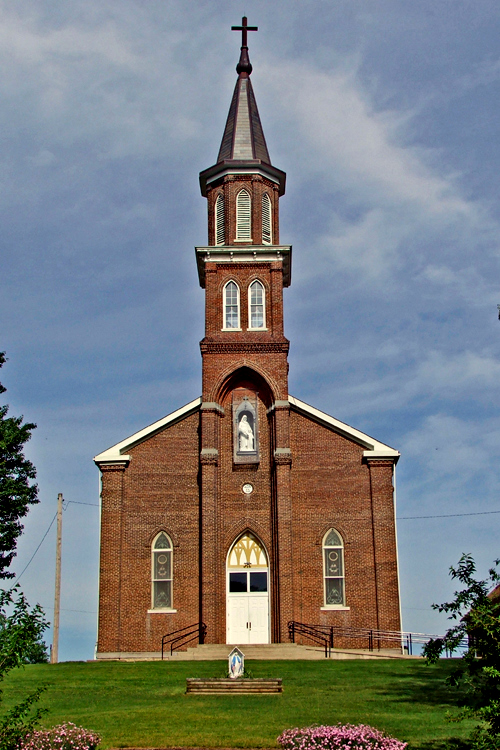
St. Jacques Catholic Church
Seingbouse, Moselle, Lorraine, France
Barbara Frisse was born on May 13, 1822, in Seingbouse, France. She was the oldest of nine children born to parents Joseph Frisse (1796-1864) and Marguerite Lang (1802-1868). She was baptized on the day of her birth at St. Jacques Catholic Church in Seingbouse; her godparents/sponsors were her paternal uncle Jean Frisse (1792-1876) and maternal aunt Barbara Lang (1806-UNK). The Church was built in 1730. It is the same church her parents, my 4x great grandparents, were married in on May 15, 1821. Both sets of her grandparents (my 5x great-grandparents) were also married here - Jean Frisse (1756-1838) and Anna Marie Weisse (1763-1826) on May 22, 1782, and Pierre Lang (1760-1831) and Christine Bour (1763-1833) on May 10, 1801.

Seingbouse is a village in the department of Moselle, in the region of Lorraine, in northeast France. The name means "the wood cleared by slash and burn". Lorraine is the only region in France to be bordered by three foreign countries - Belgium, Luxembourg, and Germany. Seingbouse covers 3.11 square miles and has a current population of a little over 1900 people. During the time that the Fries family lived in Seingbouse, between 1655 and 1846, the people spoke a German dialect called Platt. This was because of the area's close proximity to Germany.

There are at least six different spellings of the family name - Fries, Friesse, Frisse, Frise, Fris, and Frisz. In 1655 the spelling was FRIES; in 1750 the name was spelled FRISSE. The changing of the spelling from German to French was a gallacizing of the name (to make French). The German pronunciation of FRIES and the French pronunciation of FRISSE is the name - it is pronounced FREASE as in GREASE. In 1868, at the time of their mother''s death, the seven Fries boys were using several different spellings of their last name. While at her funeral the boys got together and voted on one common spelling, and FRISZ was chosen. At first everyone pronounced it FREEZE; now it is commonly pronounced FRISS - except by the descendants of Christopher in Vincennes, Indiana, who still pronounce it FREEZE.

In May of 1846 Barbara joined her parents and seven of her eight younger siblings - Jacques (Jacob), 18; George, 16; Jean (John), 12; Michel, 9; Anne, 8; Pierre (Peter), 6; Joseph, 2 - as they packed up their belongings and boarded the James N. Cooper at LeHavre, France and set sail for America. Brother Christopher, Henry, two years younger than Barbara, remained temporarily in France where he served in the French Navy (he arrived in America in 1851). After a 62-day journey they arrived safely in New Orleans, Louisiana on July 20, 1846. They then took a riverboat up the Mississippi River to Cairo, Illinois, then up the Ohio River to Madison, Indiana. From here they travelled approximately 30 miles north to St. Ann Village, Jennings County, Indiana, where friends from the old country had previously settled. They soon bought land and settled down on their farm.

St. Anne's Catholic Church
Jennings County, Indiana
Traveling also on the J.N. Cooper was Jean Michel Baptiste Brunett, age 28, who married Barbara on August 11, 1846 at St. Anne Catholic Church. They were married just 23 days after arriving in the United States. Jean Michel was also born in Seingbouse, France. His parents, Ludovici (Louis) Brunett (1800-UNK) and Catherina Schmidt (1800-1881), were residents of Moselle, France.

Barbara and Jean Michel had ten children - Mary, born June 7, 1847; Anna, born April 23, 1849; John, born November 3, 1850; Barbara F., born April 15, 1852; Margaret, born 1854; Peter, born August 7, 1857; Magdalen, born 1858; Catherine, born 1859; John George, born March 30, 1861; and Virginia "Jennie", born April 14, 1863. Their daughter Barbara is my great-great-grandmother.

Barbara and her family were some of the original members of St. Anne's Catholic Church. As her husband farmed their land, she cared for her home and children - ten in 16 years! Unfortunately their last child Jennie was born three weeks after the death of her father Jean Michel - he died at the age of 45 on March 24, 1863. Their son John had died at the age of three in 1853, so Barbara was left to raise their nine surviving children, including a newborn and four others under the age of 6.

There was no life insurance or health insurance for farmers in that day. Barbara had no daycare or preschools for her to use so that she could make money. One must assume that she went to her parents and her brothers' and sisters' families for help and support. Her father Joseph died a year after her husband, in October 1864 at the age of 68; her mother died at the age of 66, in 1868. They are all buried at St. Anne's Cemetery near North Vernon, Indiana.

Barbara lived to be 71-years-old. She died on August 22, 1893. She had given birth to ten children; she was eventually to have forty-three grandchildren and literally hundreds of great-grandchildren and great-great-grandchildren. There are at least eleven "Barbara"s who have received their names, passed down from this first-in-the-family Barbara in America.


[HOW'S IT RELATIVE? Barbara F. Brunett married Phillip Huber (1847-1901) and they had seven children including daughter Mary "Mayme" (1873-1913), who later married John Martin O'Donnell (1865-1937). MaymeJohn Huber O'Donnell (1905-1964) - my maternal grandfather.]

Sunday, February 5, 2012

SUNDAY'S OBITUARY - Patrick McCluskey (1810-1855)

Illustration of Milkman
Philadelphia Inquirer
When I took over my Dad's family history research after he passed away in 2009, I was beyond overwhelmed at the amount of information he had accumulated over his half-century of work. It had been done almost entirely without the use of computers and the Internet, and all of the resources that are now available to be searched online from the comfort of your own home. Of course there were some questions that were still unanswered, some dates missing, etc. One of these missing dates was the date of the death of my 4th great-grandfather Patrick McCluskey. Here is the story, how I found out, and the brief story I have so far on my ancestor.

Patrick McCluskey was born about 1810 in Ireland. Where in Ireland I unfortunately don't know. (I'm still searching.) He came to America in the early 1800's and established his new home in Philadelphia. Patrick and his wife Mary (born about 1810 in Ireland) were living in the Spring Garden area of the city at the time of the 1850 U.S. Census with their five children: James, 14; Charlotte Elizabeth, 13; Susan, 8; John, 6; and Sarah, 5. Patrick, 40, was a milkman. [See "Milkman: The Myth, The Legend" below] Oldest daughter Charlotte, born February 15, 1838, is my 3rd great-grandmother.

For years this was all that was known about Patrick, his wife Mary or any of Charlotte's other siblings. No death dates, location of burials, or other descendants. Recently I tried again to see if I could find out about Patrick. There are so many resources on the Internet but that doesn't mean that the information you're looking for can be found. But fortunately for us family history researchers there's always new resources added every day so I just tried again. And I found it!

DIED

Patrick McCluskey Notice of Death
Philadelphia Ledger - January 12, 1855

"On the 10th instant, PATRICK MCCLUSKEY, aged 44 years.
The relatives and friends of the family are respectfully invited to attend the funeral from his late residence, Hamilton street, between Twenty-second and Twenty-third streets, on Sunday next at 12 o'clock without further notice. To proceed to Cathedral Cemetery." [from Philadelphia Ledger, January 12, 1855]
I found an obituary for a Patrick McCluskey, but there were several Patrick McCluskeys in the city directory at the time. The age fit but could I be sure that this was the right man? There was a general address in the obituary so I needed to find something else with the known address of these ancestors to confirm the obituary.

Searching through the information I had, I checked out the "Philadelphia Death Certificate" for one of Patrick's grandchildren, Susan McCaffrey, the daughter of Charlotte and her husband Thomas McCaffrey (1832-1896). Susie, born March 3, 1856, was the second child and oldest daughter of thirteen children. The McCaffrey family was living at the time in Baltimore, Maryland. On May 28, 1861, Susie died in Philadelphia of "Scarlatina Maligna", a deadly form of Scarlet Fever. She was just five years old. The address of the place of her death was listed on her Death Certificate as "2227 Hamilton Street". This would be the same as "Hamilton street, between Twenty-second and Twenty-third streets" listed in Patrick's obituary in 1855. Obviously Susie and her family had been visiting her mother Charlotte's family in Philadelphia when she got sick and died.

While continuing to search for more information on my 3rd-great-grandmother Charlotte's brothers and sisters, I found her brothers James (1836-UNK) and John (1844-UNK) on another resource. On July 1, 1863, Philadelphia had a draft registration in the midst of the Civil War. The Confederates had moved into Pennsylvania (this was the first day of the Battle of Gettysburg) and this emergency draft was meant to be a short term commitment to service, providing protection as needed to the city. Listed on the draft sign-up were "John McCluskey", 20-year-old single laborer, and "James McCluskey", 28-year-old married laborer. The place of birth was listed for both as Philadelphia. The address listed for both was "2227 Hamilton St."

Our Mother of Sorrows Catholic Church and
Old Cathedral Cemetery - Philadelphia
So now my research continues. From Patrick's obituary I know that he was buried at the Old Cathedral Cemetery in Philadelphia. There will be records in the Archdiocese of Philadelphia of the burial with possibly the cause of his death, and maybe even the place of his birth. His tombstone may also contain some of this personal information (cross your fingers!). His wife and/or his children are most likely  buried next to him - and maybe their records will have some similarly important information recorded. I will keep looking.

Milkman: The Myth, The Legend - The Milkman in 19th Century America
I remember the milkman delivering bottles of milk to our kitchen door when I was a little girl in the early 1960's. I even remember "helping" my mother one morning bring in the milk bottles and dropping one, breaking it as it landed, and spreading the entire quart of milk across our kitchen floor. My mother wasn't happy and I'm sure I didn't "help" her again for months if not years. But the milkman that I remember bares little resemblance to the milkman of the 1800's.
Cow's milk was not the staple in American families during the 1800's that it has become during the 20th century. Those with cows in their back pastures or barns would have milk for drinking, cooking and for making butter with. Maybe they might also sell or barter their extra milk with neighbors. But as America's cities grew larger with newly arriving immigrants, many of them with farming backgrounds, households could no longer expect to have a cow close-by. But there were always farms outside the city, and the need for home milk delivery was ever-growing. Thus the milkman became a part of most households' everyday lives.

At this time there was no widespread use of refrigerators until the late 1920's, although the icebox had been in common use (when the ice had been delivered) from the 1850's on. So milk would be delivered every day, except Sunday. The milkman would leave his home early, around 3:00-4:00 am, to pick up his supply of milk from a farmer who travelled into town or from the train depot bringing in larger supplies. The milkman would have a small wooden cart, pulled by a horse, along with his supply of metal milk pails that would be filled with milk. He would then make his way along his route, knocking on his customers' doors. The lady of the house would come to the door bringing whatever container she kept the family's milk in and the milkman would take his ladle and scoop out the amount of milk she had ordered.  Then he would go to the next home.
New Orleans Milkman ca 1903

It sounds nice and simple but there were inevitable problems. This was the age before germs and viruses were understood as the cause of common illnesses, so no one could understand that germs were being spread from what the cows ate or drank; from the dirt and feces on their utters that fell into the milk; from the unwashed milk pails collecting the milk; from the hands of the farmers who were ill but still milking the cows; from the unclean milk containers of the milkmen each day; from the unwashed ladles that could spread the germs from house to house; from the milk containers of each house that had yesterday's milk still sitting in it. Then to make matters worse it was common practice among milkmen to dilute the milk that they received with water so that they had more to sell. Farmers also resorted to such behavior, especially when their cows had not produced enough milk to fill their daily quotas. And of course the water supply was very often tainted with animal and human waste, full of germs in its own right.

And who inevitably suffered the most? The major group of individuals who drank milk on a daily basis were infants and young children, those very people who were most vulnerable to illness. This spread of illness and death continued for decades, until pasteurization - the process of heating milk to a certain temperature then cooling it quickly to kill the germs - was legally required in the United States in 1917.

During the 19th century cities throughout America were faced with problems with their milk supply, from the illnesses and deaths of young babies and children who primarily drank it, to the quality of the milk itself. This New York Times article of September 2008 compared the Chinese baby-formula poisoning of that year to the milk scandal of 1858 New York, and beyond:
"The milk was marketed as pure and wholesome, and it looked fine to the naked eye. How were the mothers to know they were poisoning their babies? They had paid good money for it on the open market. It would take thousands of sick children before lawmakers did anything to stop it.
China in 2008? No, New York in 1858. The disaster unfolding now in China - and spreading inevitably to its trading partners - is eerily similar to the "swill milk" scandal that rumbled on through New York for several decades through the 19th century.
In a city growing fast, but lacking refrigeration, it was hard to provide sufficient milk. Fresh milk was brought in from Westchester and Orange Counties, but not enough to meet demand. In 1853, it was found that 90,000 or so quarts of cow's milk entered the city every day, but that number mysteriously increased to 120,000 quarts at the point of delivery.
Some of the increase was due to New York dairymen padding their milk with water, and then restoring its richness with flour - just like their latter day Chinese counterparts, who increased the protein levels in watered down milk by adding the noxious chemical melamine. But the greater part was swill milk, a filthy, bluish substance milked from cows tied up in crowded stables adjoining distilleries and fed the hot alcoholic mash left over from making whiskey. This too was doctored - with Plaster of Paris to take away the blueness, starch and eggs to thicken it and molasses to give it the buttercup hue of honest Orange County milk. This newspaper attributed the deaths of up to 8,000 children a year to this vile fluid.
The similarities between China and New York 150 years ago shouldn't come as a great surprise. Adulteration on such scandalous levels occurs in societies with a toxic combination of characteristics: a fast-growing capitalistic economy coupled with a government unable or unwilling to regulate the food supply.
In the end New York milk was cleaned up. It took stronger food laws, better policing, the advent of pasteurization and the passing of the Food and Drug Act of 1906, 50 years after the worst of swill milk. Above all it took decades, not months or years." [by Bee Wilson; September 29, 2008; New York Times Opinion Page]

Warning of Swill Milk
The United States Public Health Service, in their 1896 Public Health Report, confirmed how these illnesses and deaths were associated with drinking milk:
"Numerous instances have been observed in which outbreaks of typhoid fever, scarlet fever and diphtheria, by their sudden and explosive character, affecting families living in streets or localities supplied by the same milkman, naturally pointed to the milk supply as a common cause....These facts could not fail to invite criticism and sharpen the power of observation in others, and in consequence similar cases were more frequently reported, so that Mr. Ernest Hart in a most valuable paper, was enabled to present to the International Medical Congress held in London, 1881, the history of 50 outbreaks of typhoid fever, 15 of scarlet fever, and 7 of diphtheria, all traceable to the milk supply; but even this formidable array of facts was not accepted as conclusive, largely because the milk industry constitutes a strong spoke in the commercial wheel...." [Public Health Reports Volume 11, Issues 1-50; page 128; February 14, 1896; United States Public Health Service]
All of these connections between milk, the milkman, and childhood illnesses and deaths puts one last question that will never be answered - did Patrick McCluskey's granddaughter, Susie McCaffrey - daughter of Charlotte McCluskey McCaffrey and older sister of my great-great-grandmother Elizabeth Agnes "Lizzie" McCaffrey Flemming (1858-1922) - become infected with scarlet fever from drinking something as simple as milk, while staying at the home of her grandfather, the milkman? Patrick had been dead by then so he certainly didn't spread the illness. But it does make you wonder, doesn't it?

Thursday, January 26, 2012

THURSDAY'S TREASURES - Horst Family Bible, 1892


Stored in one of my mother's many closets in an upstairs bedroom is this family treasure - The Holy Bible given by Charles Frederick Horst (1856-1912) and his wife Odalie Felice Fortier (1857-1920) to their children on Christmas Day, December 25, 1892. The Bible will have been in the family for 120 years this coming Christmas!

Charles and Odalie Horst are my great-great-grandparents. Charles was the oldest son of Martin Horst (1830-1878) and Apollonia Weinschenk (1829-1908), both immigrants from Germany. The two had married in Mobile, Alabama, and raised their large family. Odalie was the daughter of Jacques Omer Fortier (1813-1867) and Augustine Melanie Laperle Degruy (1822-1872) of New Orleans. Charles and Odalie were married January 10, 1879 at St. Joseph's Catholic Church in Mobile.

The two soon started their own family - Charles Frederick, born November 15, 1880, and Edward Martin, born May 5, 1882. It was not long after the birth of their second son that the family moved to Cincinnati, Ohio, due to Charles' health problems (lung problems, according to family stories).  Charles' father Martin and his family had settled in Cincinnati soon after arriving in America in 1846. Martin's older sister Anna Elizabeth (1827-1877) had remained in Cincinnati after marrying John Ginter (1818-1906), and had raised their five children here. So when Charles, Odalie and their two small sons arrived they moved into the Ginter's home at "30 Rittenhouse".
Charles worked in his previous field in a bar as a bartender. Odalie had two more children here - my great-grandmother Pearl Alphonsine, on November 19, 1884, and Omer Leo, born May 5, 1887. It was while living in Ohio that Charles and Odalie purchased this Holy Bible as a Christmas gift for their children. This Bible, well over a thousand pages, was published in Newport, Kentucky. Newport is on the border of Kentucky and Ohio, at the confluence of the Ohio and Licking Rivers, directly across from Cincinnati. It is now considered part of the Greater Cincinnati Metropolitan area. It was soon after 1892 that the Horst family relocated to Birmingham, Alabama where their descendants now reside. [Charles and Odalie had their fifth child, Odalie Felice on January 20, 1896 in Birmingham.]

The book measures 9.25" x 11.5". It is leather bound with exquisite detail embossed on the cover. The binding is very worn and has deteriorated over time. The back cover is the same as the front but is not as worn. There are no family births or deaths listed, as was common to do in those times. Since it was a gift to the children it's possible that another Horst Family Bible existed (or exists) where these important dates were listed.

The pages themselves are in great condition for the most part; the edges have become well worn and some are more frayed than others. But the book is full of beautiful engraved prints throughout, and in what is labeled "Gallery of Scripture Illustrations". Here are a few examples.


            The Stations of the Cross are printed in color.

There are also several beautifully detailed prayers printed in color, using gold and red.

While looking through the book for pictures I came across a few personal items. Pressed in the pages I found a carnation on one page and what looks like an old corsage on another. The second item didn't have any discernible flowers but did have several stems and leaves wrapped together at the base with wire.


There was also an insert of a photographic print of Bishop Toolen of Mobile, with a handwritten note and his signature: "In remembrance of my twentieth anniversary. T. J. Toolen, Bishop of Mobile." Bishop Thomas Joseph Toolen (1886-1976) was Bishop of Mobile from 1927-1969.
On one of the last blank pages of the Bible was drawings, or scribbles, done by a young child with a pencil. It could have been Charles and Odalie's grandchildren or great-grandchildren scribbling in it dozens of years later. But I like to think that maybe their own children, born in the 19th century, did the same thing that my kids, and me and my siblings did, when we were little and trying to act big and opened that big book, sat down with a pencil and made their own little make on family history.

Wednesday, January 4, 2012

WONDERFUL WEDNESDAY'S PHOTOS - The 1848 Cincinnati Riverfront Panorama (restored)

The Original Display of the 1848 Cincinnati Panorama
Cincinnati Public Library
 [from "1848 Daguerreotypes Bring Middle America's Past to Life"; Julie Rehmeyer; Wired magazine; August 2010]

"In 1848, Charles Fontayne and William Porter produced one of the most famous photographs in the history of the medium — a panorama spanning some 2 miles of Cincinnati waterfront. They did it with eight 6.5- by 8.5-inch daguerreotype plates, a then-new technology that in skilled hands displays mind-blowing resolution.
Detail of Restored Panorama
Fontayne and Porter were definitely skilled, but no one knew just how amazing their images were until three years ago, when conservators at George Eastman House in Rochester, New York, began restoration work on the deteriorating plates. Magnifying glasses didn’t exhaust their detail; neither did an ultrasharp macro lens. Finally, the conservators deployed a stereo microscope. What they saw astonished them: The details — down to window curtains and wheel spokes — remained crisp even at 30X magnification. The panorama could be blown up to 170 by 20 feet without losing clarity; a digicam would have to record 140,000 megapixels per shot to match that. Under the microscope, the plates revealed a vanished world, the earliest known record of an urbanizing America.

Detail of Restored Panorama
But the conservators also found trouble. At that magnification, dust motes smaller than red blood cells became image-obscuring blobs. Corrosion from a few molecules of water obscured a face peeking out a window. Even polishing marks from the original preparation of the plates became a mass of dark streaks.

Trying to restore the plates themselves might have damaged the images, and the conservators didn’t want to risk ruining the finest American daguerreotypes in existence. So they put them in a case filled with inert argon gas to arrest the deterioration and went digital, turning to computer vision specialists at the University of Rochester. To them, the images were just noisy data, which they knew how to scrub.

Now Fontayne and Porter’s daguerreotypes are stabilized and its details restored — 21st-century technology rescued an image from the 19th.

As a historical record, the Fontayne-Porter daguerreotype is unparalleled. It contains the first photographic images of steamboats, a railroad station, and one of the country’s earliest astronomical observatories. It may also be one of the earliest pictures to show free blacks, who were building a community in Cincinnati, just across the line from Kentucky slave country. A ditch running from the corner of a building down to the river — eroded by effluent from an outhouse — presages the cholera epidemic that hit the city the following year.
Even artifacts of daguerreotype preparation yielded new knowledge. The silver surface of an unexposed daguerreotype is tricky to polish to a mirror finish — even the finest cloths or brushes leave tracks that are clearly visible at high magnification. But the art historians didn’t want those marks removed; they wanted to be able to enhance them. It turns out that the streaks act as signatures. Each daguerreotypist had a distinct method of polishing — sweeping tiny suspended brushes across the plate or hand-polishing (as Fontayne and Porter did) with carefully chosen cloths. The resulting patterns vary, but in a small region they all look like very fine, roughly parallel dark lines. So Messing, Ardis, Tang, and their collaborators designed an algorithm to detect these unique patterns and bleach out the rest of the image.
After all the restoration, historians now know the exact hour and minute when the image was captured. Back in 1947, steamboat enthusiast Frederick Way and Cincinnati Public Library director Carl Vitz undertook an extensive historical investigation of the daguerreotype, using steamboat records to identify the only date on which all of those vessels were in Cincinnati: September 24, 1848. And by analyzing the angles of shadows, they figured the shots must have been taken just before 2 pm. A clock tower showed the time, but however much the researchers strained to read the 1-millimeter-diameter clock face with a magnifying glass, they couldn’t make it out.
After the images emerged from Eastman House’s microscope scanner, the team cheered when they saw the clock tower: It read 1:55."
Detail of Restored Panorama
Check This Out!
The Cincinnati Public Library has a website dedicated to viewing this amazing restoration - http://1848.cincinnatilibrary.org.

You are able to see each of the eight restored plates online, then zoom into the image to see first hand its clarity and its details. It will ASTOUND YOU! Many of the buildings and areas are also described for their historical significance.

And to think it is very possible, even probable that my Horst ancestors - Johann Eckhard Horst (1802-1852), my 4th great-grandfather, and Martin Horst (1830-1878), my 3rd great-grandfather - were living in the city on the day that this photograph was taken. What an opportunity to see exactly what the city looked like over 160 years ago!?!

Tuesday, January 3, 2012

HOMETOWN TUESDAY -- Cincinnati, Ohio, Part I

On August 7, 1846, my great-great-great-grandfather Martin Horst arrived in New York City, along with his father Johann Eckhard Horst (1802-1852), step-mother Elisa Geiss (1817-1852), older sister Anna Elizabeth (1827-1877), younger brother Carl (1835-1900) and two half-sisters, Wilhelmena "Mina" (1843-1885) and Maria (1845-UNK). Martin was just 16 years old. He and his family had arrived on the ship Gladiator, landing in New York Harbor as thousands had before them and hundreds of thousands would after - as immigrants hoping to start a new life in America. In fact during the 1840's more than 1.7 million immigrants arrived in the United States, almost three times as many as had come the decade before. Martin and his family had left their home in the village of Omer-Ohmen, in the Grand-Duchy of Hesse-Darmstadt, at the time a member of the German Confederation.

The Horsts stayed briefly on the east coast. On September 28, 1847, Martin became a naturalized citizen at the U.S. District Court in Baltimore, Maryland. At some point soon after this the family travelled to Cincinnati, Hamilton County, Ohio, where they would settle down.
from the Cincinnati Panorama of 1848
Fontayne and Porter Daguerreotype
(more about this photograph in panorama tomorrow - don't miss it!)

The History of Cincinnati, Ohio
[The following information is taken from OhioHistoryCenter.org, an online encyclopedia of Ohio and its history.] 
"In 1788, Israel Ludlow, Matthias Denman, and Robert Patterson purchased eight hundred acres from John Cleves Symmes along the Ohio River at the Licking River's mouth. Symmes had purchased two million acres of land from the Confederation Congress in 1787, hoping to become rich by selling land to others. Denman provided the necessary cash; Patterson found settlers; and Ludlow surveyed the land to make sales and also establish a town. They named the town Losantiville, a convoluted contraction of the idea that this was a "city across from the mouth of the Licking River." 
Law and order remained absent from Cincinnati during its early years. The settlers (around 700 total by 1790) organized a court and hired a sheriff, but the soldiers at nearby Fort Washington routinely had to establish martial law in the community. This became especially common as tensions increased with local Native Americans, especially the Shawnee Indians. Contributing to the lawlessness, many residents grew corn, which they distilled into alcohol and sold to the soldiers. Despite the lack of order and the various safety concerns, hundreds of settlers continued to flock to the town. They believed that they could make their fortunes providing the soldiers and people traveling down the Ohio River with supplies.  In 1803, the city had roughly one thousand civilian residents. It continued to grow, reaching nearly ten thousand people by 1820. Cincinnati had emerged as a major city, primarily due to its strategic location on the Ohio River. 
"Pork Packing in Cincinnati"
from 1873 Vienna Expo
 During the nineteenth century, Cincinnati continued to grow. The Ohio River provided Cincinnati residents with numerous business opportunities. Hotels, restaurants, and taverns quickly opened to meet the needs of settlers traveling westward on the Ohio River. Steamboats were manufactured and repaired in the city. Farmers brought their crops to the city to send down the Ohio and Mississippi Rivers to New Orleans, one of Ohio's major markets.  
The Miami and Erie Canal made the trip from western Ohio to Cincinnati much easier and less expensive for local farmers. In the early 1800s, Cincinnati developed into an important meatpacking center. Farmers brought their livestock to the city, where it was slaughtered, processed, and sold to western settlers or shipped to various markets. Beginning in the 1830s, ethnic Germans began to settle in Cincinnati. During this time period, Cincinnati was becoming the pork-processing center of the United States. Because of Cincinnati's association with meatpacking, the city became known as the "Porkopolis" of the United States.
Some residents opposed the activities of others in the city and actively campaigned to reform the community. The temperance movement targeted the Germans and the Irish, who were alleged to be well-known for their heavy drinking. Ohio abolitionists utilized Cincinnati to campaign against slavery. Located directly across the Ohio River from Kentucky, a slaveholding state, Cincinnati abolitionists published newspapers and anti-slavery tracts, hoping to convince their slaveholding neighbors to free their slaves. Participants in the Underground Railroad also smuggled runaway slaves across the Ohio River to potential freedom in the North.  
Not all white Ohioans supported the abolitionists. Many of these people feared that, if slavery ended, they would face competition from the freed African Americans. Race riots sometimes occurred, especially if whites feared that African Americans were gaining too much power or were infringing upon white opportunities. In 1829, one such riot occurred in Cincinnati, because Irish immigrants disliked competition from the African-American community.  
During the Civil War, most residents supported the United States, but a sizable number of people went south to fight for the Confederacy. Cincinnati served as a major recruiting and organization center for the United States military during this time. The city's businesses thrived, as they provided supplies to the soldiers and housing for both the soldiers and their families. Various charity organizations also were present in the city to help soldiers and their families."
Germans in "Zinzinnati"

1855 Cincinnati Riots
Published in Illustrated London News 1855
"Beginning in the 1830s, large numbers of Germans began to settle in Cincinnati. Many Germans lived in the area of Cincinnati known as Over-the-Rhine
Because of violent episodes like the one that occurred in Cincinnati in 1855, German immigrants tended to establish their own communities. During the nineteenth and early twentieth centuries, many native-born Americans feared outsiders. Some of these people objected to the immigrants' religious and cultural beliefs, while others believed that the foreigners would corrupt the morals of United States citizens.  
These people also contended that the quality of life within the United States would decline, as there were not enough jobs to employ the millions of people migrating to America. Many native-born Americans hoped either to limit immigration or to force foreigners to convert to American customs and beliefs. It would take several generations before the immigrants became truly accepted by the vast majority of white Ohioans." (from OhioHistoryCentral.org)
"German immigrants were responsible for developing industries that are considered "native" to Cincinnati, such as meat packing, the machine industry and building trades.
Albert Stein, a German engineer, planned Zinzinnati's water works in 1817. Frederick Rammelsberg of Hanover introduced machine production of furniture. The brewing industry in Zinzinnati, and across the United States, was a creation of German-American businessmen. The famous Christian Moerlein Brewery was started here in 1853.
Local banking grew out of the thriftiness of the German population. Germans established mutual savings societies and credit unions, and loaned money at interest at their weekly meetings. These meetings were frequently held in a tavern over a glass of beer, and with a staff that consisted of a part-time secretary. 
Baking is yet another industry that Germans established in Zinzinnati. There were also many small baking establishments operated by German-Americans in various Zinzinnati neighborhoods. In fact, there were so many German bakers that they even formed their own singing society - the Baeckergesangverein." (German-American Heritage Teaching Guide, Dr. Don Heinrich Tolzmann, University of Cincinnati)
Over-the-Rhine Neighborhood

Miami & Erie Canal
[taken before 1920 when it was used to build city subway, later paved over]
"The completion of the Miami & Erie Canal in 1828 became the catalyst for making Cincinnati the central trading hub west of the Appalachian Mountains. The canal linked the Great Lakes with the Ohio River, and all the Ohio farmland in between. The Over-the-Rhine neighborhood was full of saloons, beer gardens, restaurants, and theatres that catered to tastes ranging from legitimate theatre to burlesque. OTR was also a power center where corrupt Republican Party head "Boss" Cox ran the city through deals and schemes hatched at beer halls like Wielert's, still standing on Vine St..
1841 Lithograph of Cincinnati
Miami and Erie Canal in foreground
The canal that helped grow the city also gave Over-the-Rhine its name. Immigrants from Germanic countries began arriving in Cincinnati in increasingly large numbers starting in the1830s. In German, the district was called "über'm Rhein." Although Germans were among the city’s first settlers, they constituted a small percentage of the population until the city’s rapid growth in the mid-1800s. When the Germans began arriving in Cincinnati in larger numbers, starting in the 1830's, the area north of the Miami & Erie Canal was mostly gardens and farmland. The Germans transformed it into a bustling neighborhood. It developed such a high concentration of German-Americans that traveling over the bridges spanning the canal became known as "going over the Rhine," a tongue-in-cheek reference to Germany's Rhine River. At its peak of population, Over-the-Rhine was home to more than 45,000 people, roughly 75% of which were first or second-generation German-Americans." (from otrfoundation.org)
Six million dollars was spent in the 1920's to use the bed of the canal to build a downtown subway in Cincinnati. The surface was later paved over to form Central Parkway as funds ran out before the Cincinnati Subway was completed.

NOTE:  Over-the-Rhine was added to the National Register of Historic Places in 1983 with 943 contributing buildings. It contains the largest collection of Italianate architecture in the United States and is an example of a 19th-century intact urban neighborhood. Its architectural significance has been compared to the French Quarter in New Orleans, the historic districts of Savannah, GA, Charleston, SC and Greenwich Village, NY.

[Next Week in "Hometown Tuesday" - The Horsts in "Cincinnati"]

Sunday, January 1, 2012

SATURDAY'S STRUCTURE - Packet Ship Gladiator (1846)

In recognition of the new year that has just begun, it's a good time to write about a very important structure - the ship Gladiator. This is the ship that my 4th great-grandfather Ekhard Horst and his son, my 3rd great-grandfather Martin Horst and several members of their family travelled on in 1846 when they left their home in Hesse-Darmstadt, Germany, leaving their extended family, their friends and all they knew to start over in a new country they had never laid eyes on before. We've heard it all in school, how the new immigrants arrived on ships into New York Harbor, passed through Ellis Island before they were allowed to enter the country. But this story is not that simple, not that easy.

First, it's important to know that Ellis Island didn't open it's doors until January 1, 1892 (120 years ago today). The federal government had just taken over control of immigration in 1890. Before then it was the role of officials from the city where the port was located to process new arrivals. Before Ellis Island, Castle Garden  Emigrant Landing Depot functioned as the New York state immigration processing center, between 1855 and 1890. But the Horst family arrived in 1846, years before such official processing took place.

A Packet Ship Off Liverpool
Second, we probably think we can imagine what it was like to be a passenger on a ship to America - mostly from movies like Titanic, with its Irish passengers in 3rd Class who slept in little rooms with bunk beds and ate meals in little crowded common areas. But Titanic was a steamship, making its first run in 1912. Steamships did not become the main mode of transportation for most ocean travel until after the Civil War. There were a few steamships carrying passengers in the 1850's but most new arrivals came to America on packet ships. The Gladiator was one of these ships. Packet ships were so called because they originally carried mail and cargo; later, transporting people across the ocean became a new way to make money for the ships' owners.


Horst Family Sets Sail for America

John Ekhard Horst (1802-1852), my 4th great-grandfather, his second wife Eliza Geiss (1817-1852) and their children arrived in America in New York City harbor on August 7, 1846. Ekhard's first wife and my 4th great-grandmother, Elizabeth Martin (UNK-before 1842) had died in Germany, leaving four young children. Ekhard married Eliza around 1842 and they had two daughters. The children travelling with them were, from his first marriage, Elizabeth, age 19; Martin (my 3rd-great-grandfather), 16; Carl, 12; and their two young children Mina (Wilhelmina), 3, and Maria, their baby. Conrad, age 14 at the time, remained temporarily in Germany. Ekhard, as he was listed on the manifest, gave his occupation as “farmer”.
Passenger List from Gladiator, August 1846
[l to r: Name; Age; Sex; Occupation; Nationality (German, Do=ditto), Destination (America)
The family had sailed on the ship Gladiator, departing from London, England, under the ship’s Captain Richard L. Bunting. Martin and his family travelled to America along with 209 other immigrants in “steerage”, as most immigrants at that time did. [See "Steerage" below for more insight into their voyage.] Also on board were 11 passengers who stayed in cabins, including three men whose occupation was listed as “gent”.  On the Horst family’s trip six passengers died – which often occurred on these long travels -  including 4-year-old Catherina Grafen; 11-month-old Johan Giltz; 64-year-old Eva Risinger; and 10-year-old Catherine Rettig, all Germans.

[It's interesting to note, when they arrived in August 1846 into New York Harbor there was no central facility for the new immigrants to get information for housing, food, jobs or medical care. So it was common for new arrivals to be robbed, taken advantage of, and mistreated. If they were fortunate when they arrived they may have been assisted by the Deutsche Geselleschaft, the German Emigrant Society that had been organized in the city to help relocate newly arriving Germans, provide information on travel, housing and jobs, and protect them from the bands of thieves that populated the harbor area. German Catholic Churches were also set up to help new immigrants.]


Boarding Packet Ship
ca. 1851
Steerage
"Steerage in the mid-19th century typically consisted of the area immediately below the main deck of a sailing ship. The ceiling height of the between-deck was usually 6 to 8 feet. The bunks, made of rough boards, were set up along both sides of the ship. The bunks were ordinarily positioned so the passengers lay in the direction of the ship, from fore to aft, but on a few ships the bunks were placed transversely or “thwartships”.Obviously this caused passengers greater discomfort in rough seas. The larger ships might also have an additional row of bunks in the middle. On these ships there was only a small corridor between the bunks. Each bunk was intended to hold from three to six persons, and these were often called family bunks. If passengers were lucky, there would be enough head-room to be able to sit up on their beds.

Families brought with them all of their worldly possessions as they resettled in the new country, but this was only part of what they carried with them onto the ship. They were also required to bring their own mattresses (stuffed with hay or horsehair) for their family’s bunk bed, and sometimes even all their own food and cooking supplies for the long journey. Water would be available but good hygiene was not.

The emigrants were also advised to take along equipment, such as a water pail, (the size according to the needs of each family, about 3 quarts a day per person) cooking pot, coffee kettle and dishes and eating utensils. They had to prepare their own food on the ship's galleys placed up on deck. Often there were no more than a couple of these to be shared by all the passengers. The lines for preparing food could easily become long, when there were several hundred passengers. There are reports about ships where some passengers never made it to the stoves -- it was a matter of the survival of the fittest. A passenger traveling on theAtalanta in 1871 told this from his journey: "Now our place as emigrants was in the hold, on the between deck. Everyone had a chest of food, a keg of milk and one of beer, all of what was stored in the mid of the deck, held in place by ropes."

"From Liverpool each passenger receives weekly 5 lbs. of oatmeal, 2 1/2 lbs. biscuit, 1 lb. flour, 2 lbs. rice, 1/2 lb. sugar, 1/2 lb. molasses, and 2 ounces of tea. He is obliged to cook it the best way he can in a cook shop 12 feet by 6! This is the cause of so many quarrels and...many a poor woman with her children can get but one meal done, and sometimes they get nothing warm for days and nights when a gale of wind is blowing and the sea is mountains high and breaking over the ship in all directions."—Anonymous, New-York Daily Times, October 15, 1851 [This report of conditions in steerage was written by a doctor who had crossed the Atlantic many times on large American packet ships. “Reform must be made,” he wrote, “to better the condition of the poorer classes of emigrants.”]

Steerage ca. 1851
Sometimes only daily rations of wood and water were included in the price of the ticket. The emigrants on board the sail ships were completely dependent on wind and weather. If the weather was bad, the journey could take much longer than anticipated. There were several occasions when the emigrants ran out of food and water before they arrived in port.

Light was admitted through open hatchways and partly through skylights in the deck. There was canvas in the hatchways, but during storms and rough seas these often had to be covered, and if this continued for any length of time the air in the room below occupied by the emigrants often became frightfully bad.

Sometimes those in steerage were not allowed on deck or may only be allowed for a short time. Some captains had a strict routine for the steerage passengers to follow, including what time to wake and sleep, when meals were made and a list of chores to be done daily, including cleaning the steerage floor every morning for the men; other captains didn’t make the effort. Besides watching their children or caring for the sick, women would spend their time cooking sewing or knitting. Games were played and there was often dancing and music provided by those on board. The captain usually held Sunday services on deck.

Illness was common given the poor hygiene, lack of ventilation and cramped living conditions passengers had to endure. Seasickness was very common and there was no medicine to relieve it. Sometimes sick passengers were kept on deck to keep the steerage area cleaner. But with bad weather, passengers stayed in, hatches were closed and ventilation was non-existent. Primitive toilets, if they existed, were kept on deck, with sometimes only one or two available for the several hundred emigrants to use.

Inside a Packet Ship ca.1851
[click to enlarge]
The most common illnesses for passengers to suffer from at this time were cholera, typhoid fever, measles, chicken pox and dysentery. It was very common for passengers to die en route and families had to suffer further when their loved one’s body was dropped into the ocean. Passengers arriving sick with contagious or infectious diseases were quickly quarantined at the Marine Hospital at Staten Island." [From norwayheritage.com]

So now picture it - there were eight Horst family members boarding this ship, carrying with them all of their worldly belongings - two parents and six children, including one infant. They joined over 200 other passengers from various countries, all strangers sharing a very small area inside the dark ship for over six weeks. No electricity or air conditioning. Windows closed during bad weather. People getting sea-sick. Babies crying, Men snoring. People talking. No televisions or radios to keep the children entertained. No showers. Passengers getting sick. Several passengers even dying. Then having a service onboard before dropping the bodies into the ocean. Martin Horst was just 16 years old. What a difference his decision, and his family's decision to come to America made in the lives of his descendants.

The Gladiator & Audubon
An interesting note about the ship - John James Audubon (1785-1851), the renowned French naturalist and painter, sailed with his son John (1812-1862) from Portsmouth, England, to America on August 2, 1836 on the packet Gladiator. With them they brought 260 live birds, 3 pointers and "a brace of tailless (Manx) cats". They reached New York in thirty-three days. Audubon wrote in his journal:
"August 1. Somewhat before the setting of the sun, we went on board, ate and drank, and laid ourselves down in those floating catacombs, vulgarly called berths. When the Gladiator left St. Katharine's Dock she had on our account two-hundred and sixty live birds, three dogs received as a present from our noble friend, the Earl of Derby, and a brace of tailless cats...." [John James Audubon]
By the end of the trip only fifteen of the birds had survived; "the cats are well", Audubon wrote his wife Lucy. One of the pointers had delivered seven puppies.

I can find no picture of the ship Gladiator