My Adventure Through Our Family Tree Branches

For over 50 years my Dad researched both his and my Mom's family tree branches - and loved every minute of it! Trying to fulfill the promise I made him the last month of his life, I have spent the past four years continuing where he left off - finding out about all the many family members who came before us, from the many branches of our family trees. The histories will still be published as my Dad always wanted. But what he wanted most was to share the stories of the people who came before us - the places they lived, the cultures of the times, the families they created, and the circumstances - good and bad - that would one day lead to us, their descendants. These are the stories of my Mom's families. . . .

Surnames in this Blog

BRUNETT, DeGRUY, DeLERY, FLEMMING, FORTIER, FRISSE, HORST, HUBER, JACKSON, McCAFFREY, McCLUSKEY, O'DONNELL, WEINSCHENK


Tuesday, October 29, 2013

HOMETOWN TUESDAY - St. Anne's Village, Jennings County, Indiana

My great-great-grandmother Barbara Brunett Huber was born in St. Anne's Village, in the Sand Creek Township of Jennings County, Indiana, on April 16, 1852. She was the fourth child of ten born to John Michael Baptiste Brunett (1818-1863) and Barbara Frisse (1822-1893), my 3x-great-grandparents. Both John and Barbara had immigrated from Seingbouse, France, and had married at St. Anne's Catholic Church in August 1846, less than two months after arriving in America. It was here in St. Anne's Village that all of their children were born, and where John and Barbara are buried.

Also settling here from Seingbouse were Joseph Frise (1796-1864) and Marguerite Lang (1802-1868), Barbara's parents and my 4x-great-grandparents, as well as all nine of their children. Joseph and Marguerite are also buried at St. Anne's Church Cemetery. [NOTE: The spelling of Joseph's last name was 'Frise' or 'Frisse', pronounced FREEZE. It was also sometimes spelled 'Frisz'. It was at the funeral of their mother that the sons decided to adopt a common spelling - F-R-I-S-Z.]

Joseph Frise was a farmer, as most citizens of the county were. His son-in-law John Brunett also was a farmer, until his death in 1863. His wife Barbara then took over the responsibilities of farming, as well as being the mother of ten children, ages 0-16. [In fact Barbara gave birth to baby #10 one month after losing her husband.] Her land is highlighted in the Sand Creek Township map below.

Jennings County History
[from Biographical & Historical Souvenir for the counties of Clark, Crawford, Harrison, Floyd, Jefferson, Jennings, Scott and Washington, Indiana; 1889; published by John M. Gresham and Company; Chicago; pages 222-227 ]
"Jennings County lies in the southern part of Indiana. It was organized in 1816, and named for Jonathan Jennings, the first Governor of Indiana, after it was admitted into the Union as a State. ...It contains 375 square miles and by the census of the 1880 it had 16,453.
Heavy timber originally covered the county. As a general rule, the rolling lands bordering the numerous streams are more productive than the flat (lands). The principal productions are corn, wheat, oats, rye, buckwheat and hay. ...A considerable area is in pasture and large number of mules, horses and cattle are raised for the Cincinnati and other markets. Large numbers of hogs are fattened for the various markets....
Fruit culture is becoming more and more extensive every year and the soil proves that it is a good fruit region. The usual varieties of summer and winter apples do well; occasionally cherries and pears. ...Wild blackberries grow in profusion and are quite a source of income at some points, also wild grapes.
Jennings County was settled principally from the Southern  States - most of the early settlers coming from Virginia, North Carolina and Tennessee, with a number of families from Kentucky. They were of that hardy class whose trials and hardships were as nothing compared to the longing desire to possess a home of their own. ...They did not come in great rushing crowds as emigrants now go West, on railroad trains, but they come on foot, in ox-wagons, on horseback and, in fact, any way they could get here.
Vernon, the county seat of Jennings County, is beautifully situated at the North and South forks of the Muscatatuck river, and on the Jeffersonville, Madison and Indianapolis railroad. It is a rather dull old town of 616 inhabitants by the last census (1880), but has a sound and solid foundation from a financial and business standpoint. The courthouse is a handsome brick structure, with white limestone trimmings, obtained from the neighboring quarries. ...There is, and has been, considerable manufacturing done in Vernon among which may be mentioned spoke and hub factory; foundry and plow shop; stave and heading factory; woolen and flouring mill; wagons and buggies; pumps and rakes; etc., etc., etc."
1889 Sand Creek Township Map
Barbara Brunett's land in purple
[CLICK TO ENLARGE]
Sand Creek Township
"Sand Creek Township is believed to have been organized in 1841. One of Jennings County's smaller townships, it contains a little over twenty-six square miles. When Indiana became a state and Jennings a county, the northwest corner of this township belonged to the Indians. The Old Indiana Boundary line ccan be found on maps yet today.

Sand Creek derives its name from the stream that winds through it, creating areas that cannot be surpassed for beauty. The Indians had a name for this creek, Laquekaouenek (lak/ka/oo/e/nek), which means "water running through sand." [Jennings County, Indiana, 1816-1999; Jennings County Historical Society; 1999; page 91]

St. Anne's Village
"St. Anne is a German settlement situated in the southeastern part of Sand Creek township. Among the first settlers were families named Frisz, Gasper, Glatt, Eder, Specht, Daeger, Winters, Shulthies, Henry, Erlsland, Frederick, Gehl, Meyer and Tipps. Although no town was laid out, St. Anne had a post office... a grocery story... and several blacksmith shops."[Jennings County Indiana, 1816-1999; page 91]

The village was centered around St. Anne's Catholic Church, organized by February 1841. [Read more in an upcoming post.]

Jennings County Facts
Jennings County Courthouse
Vernon, Indiana
As of the 2000 Census, there were 27,554 people living in Jennings County. The racial makeup of the county is 97.45% white.  It is a rural county, with the majority of  the county made up of personal farms and woodlands.

There are only two incorporated towns in the county - Vernon, the county seat, and North Vernon. There are 11 townships in the county.[Townships are a product of Indiana's history. There are just over 1000 Townships in the state. Indiana is one of 20 states that currently has some form of township government.]

The county is conveniently located in the center of an imaginary triangle consisting of Indianapolis, IN, Louisville, KY, and Cincinnati, OH, and requires only a hour and 1/4 drive time to any of these urban centers.

In recent years, average temperatures in Vernon have ranged from a low of 22 F in January to a high of 86 F in July. President Richard Nixon's mother, Hannah Milhous Nixon, was born near Butlerville, Jennings County, Indiana, in 1885.


Wednesday, October 23, 2013

WONDERFUL WEDNESDAY'S PHOTOS - 1993 Flemming Family Reunion

Descendants of Charles and Elizabeth Flemming
Oak Mountain State Park, Birmingham, Alabama - June 1993

On the last weekend of June in 1993, family from all over the country gathered together for the first reunion in over a decade of the descendants of Charles Clinton Flemming (1854-1932) and Elizabeth Agnes McCaffrey (1858-1922).  Over 200 family members, five generations, came to Birmingham, Alabama - from 4-month old twins (my niece and nephew) to my 97-year-old great-great-great-aunt. They came from at least 10 states, from all over the country - from as far away as Illinois, Colorado and California. One family even flew in from the Philippines.

Charlie and Lizzie Flemming, my great-great-grandparents, had eleven children. Of the eleven, only four children had children of their own. Their children, Charlie & Lizzie's grandchildren, totaled twenty-one. When the 1993 Flemming Family Reunion was held there were twelve grandchildren still living, ages 69 to 83 years old. Of those twelve grandchildren, 11 attended the reunion. Everyone else were great grandchildren & their spouses, great-great-grandchildren & their spouses, and great-great-great-grandchildren.

When the next Flemming Family Reunion is held - next Summer? - there will be a completely new generation of descendants of Charlie & Lizzie Flemming. Will you be there?

Sunday, September 8, 2013

SUNDAY'S OBITUARY - Phillip Huber (1847-1901)

Death of Mr. Phil Huber
"Mr. Phil Huber died Thursday after a brief illness. Mr. Huber moved here about three months ago from Bowling Green, Ky.
He leaves three daughters and one son, Misses Minnie, Mayme, and Lena, and Charles.
The remains were taken to Bowling Green, Ky., for internment." [from Birmingham News]

"Philip Huber died this morning after a long illness with typhoid fever. Mr. Huber came here several months ago from Kentucky. He leaves a wife and several grown children." [from Birmingham Age-Herald; April 5, 1901]
Phillip Huber was my great-great-grandfather. Born in Flörsheim, Main-Taunus-Kreis, Hessen, Germany, on December 17, 1847, to Georg Huber (1809-1900) and Eva Katharina Fauth (1807-1875), Phil immigrated to America in June of 1867. Arriving in New York, he soon settled in Bowling Green, Warren County, Kentucky. He married Barbara Brunett (1852-1896), my great-great-grandmother, on April 25, 1871, and together they had seven children.

Phil worked for many years as a miller in Bowling Green, learning to read, write and speak English - something he could not do as was reported in the 1870 Census. By 1900 he was a Saloon Keeper. His wife Bridget had died in 1896. He had also buried three of his children: oldest child John William, known as"Willie," (1872-1898); Ida Catherine (1875-1879); and Clarence Joseph (1879-1900). Soon after the 1900 Census was taken, Phil moved to Bessemer, Jefferson County, Alabama, with his four grown children: Mary Bertha, called "Mayme", 27, a school teacher (and my great-grandmother); Philomena Barbara, called "Minnie", 24; Magdelena Hilbert, known as "Lena", 18; and Charles Thomas, 17.

Within just a few months of moving to Alabama, Phil contracted Typhoid Fever. He apparently had set up a Saloon in Bessemer, as the inventory of his possessions at the time of his death included: 5 bottles cherry and pineapple; 12 quarts whiskey; 24 pints champagne; 8 bottles Rhine wine; 20 quarts wine; 6 dozen bar glasses; 1/4 barrel corn whiskey; 1/5 barrel Apple brandy; 5 dozen empty bottles; 30 stone jugs.

According to the notices of his death (above) he had lived in Bessemer only 3 months. He became ill fairly quickly and suffered quite a while with this illness.  The disease was painful [click this link for a complete description: ILLNESSES-TYPHOID ] and which could be (but was not always) deadly. Unfortunately, in this case it  was. Phillip Huber died in the early morning hours of Thursday, April 4, 1901. He was just 53 years old. His body was transported back to Bowling Green on a train, where he was buried next to his wife and three children at St. Joseph's Catholic Church Cemetery. No headstone exists.

After their father's death daughter Mayme (my great-grandmother), still unmarried at this time, became legal guardian to her younger siblings - Lena, 18 and Charles, 17.

Typhoid Fever in Jefferson County, Alabama
A report by Dr. J.M. Mason, County Health Officer, to the Jefferson County Board of Health, stated that for the year 1901 there were 38 deaths from Typhoid Fever. The report also stated, "In order to prevent the spread of infectious diseases, the city has purchased the best obtainable Formaldehyde Generator, and each house in which an infectious disease occurs, is thoroughly disinfected by the city sanitary inspectors before the placard is removed. Each case of infectious disease is also reported to the school authorities as soon as reported to this office, and in this way school children from infected homes are excluded from school." [The Alabama Medical Journal, Vol. 14, No.5; Medical Association of the State of Alabama; April 1902.]

In 1906, the Sanitary Commission in Jefferson County recognized the need for a way for the county to enforce laws regarding its sewer system, in order to regulate the sanitation and health of the citizens of the county. Working with the Commercial Club of Birmingham, a "Greater Birmingham Commission" was nominated to push for legislation to annex surrounding municipalities and un-incorporated areas to create Greater Birmingham.

When the proposal was under consideration by the State Senate in 1907, eighty-one physicians sent the following letter to each State Senator:
"To the Alabama State Senate:
We the undersigned physicians of Birmingham, Alabama, most urgently request you, on behalf of the people of the entire citizenship of this city and the adjoining towns, to pass the King Greater Birmingham bill now pending before your body.
We are now afflicted with local epidemic of typhoid fever, and unless all this territory is put under our city government and the sanitation is urgently enforced we may suffer terrible consequences in the future from the ravages of said epidemic. We regard the passage of this bill as absolutely necessary for the public safety."
In August 1907 the Greater Birmingham Bill was enacted into law, incorporating eleven municipalities and a large amount of unincorporated areas into the city of Birmingham, effective 1909.


from Birmingham News, September 28, 1948 (p.2)
Continual need for improvements within the city's sanitation system grew as the population grew. In September 1947, under a proposal by the Jefferson County Commission, the State passed an Act which proposed an amendment to the State Constitution authorizing Jefferson County to issue bonds, with voter approval, to financially support the improvements of the sewer system, as well as to give full control to the county, without the need for approval from the State. There was broad support for the amendment. County Health Officer Dr. George A. Dennison was an outspoken proponent, reminding the public that in the early 20th century, Birmingham had been known as "the Typhoid Capital of the World" and that overhauling the sanitation system was key to keeping the city from being closely associated with "filth-borne diseases." [Click on article above right to read more] The Jefferson County Sewer Amendment passed by a substantial majority in the November 1948 general election, giving the county important financial powers that had been unavailable to the administration of the Sanitary Sewer System of the past. [The History of the Jefferson County Sanitary Sewer System; Public Affairs Research Council, November 2001]

Thursday, September 5, 2013

THURSDAY'S TREASURE - Our Family Name, Barbara

In my grandfather's Bible, my mother once found this small article from a long-forgotten newspaper (copyright 1920) that he had torn out and saved. It is her name - Barbara. A name that has been passed down one branch of my family tree - from one continent to another, across states, for over 200 years. The name was chosen each time by new parents for their brand new baby daughter, to honor a mother or grandmother or sister whom they loved. Here is how my mother, and my older sister, came to have their name.

In our family I have been able to trace the name Barbara back to 18th century France. I found the name first given to my 6th great-grandmother Barbe Breyer Bour, born June 20, 1750, in Seingbouse, Moselle, France. [Barbe is the French personal name for Barbara.] Her parents, my 7th great-grandparents, were Pierre Breyer (1714-1764) and Anna Marie Schwartz (1713-1761). In February 1770, Barbe married Jean Melchoir Bour, who was born January 1745, in Tenteling, Moselle, France. They had at least two children, including Christine Bour, my 5th great-grandmother.

Christine Bour was born January 1763, in Seingbouse. In 1801 she married Pierre Lang, my 5th great-grandfather. Pierre was born March 1760, also in Seingbouse, France. Together they had at least five children. Their oldest child was Marguerite Lang, my 4th great-grandmother. She was born in April 1802; fourth child and younger sister, Barbe Lang, was born March 1806.

In May 1821, Marguerite married Joseph Frise (1796-1863) in their hometown. They had seven sons and two daughters. Their oldest child was Barbara Frisse, born in May 1822. Barbara is my 3rd great-grandmother. Joseph, Marguerite and their children immigrated to the United States. They settled in St. Anne's Village (now North Vernon), Jennings County, Indiana.

Barbara Frisse married Jean Michael Baptiste Brunette (1818-1863) one month after arriving in America, in August 1846. They had ten children, 7 girls and 3 boys. The name is passed down again at the birth of their fourth child Barbara Brunett. Born in April 1852, Barbara married Philip Huber (1847-1901), an immigrant from Germany, in April 1871, in Bowling Green, Warren County, Kentucky. Barbara and Philip are my 3rd great-grandparents.

Barbara and Philip had seven children while living in Bowling Green, including (my great-great-grandmother) oldest daughter Mary Bertha "Mayme" Huber, born in August 1873, and her younger sister Philomena Barbara "Minnie" Huber, born September 1876. Minnie never married. Mayme married John Martin O'Donnell (1865-1937) in April 1904, after both had moved to Birmingham, Alabama.

Mayme and Johnny had three boys, including oldest son John Huber O'Donnell (my grandfather), born May 1906, and one daughter, Barbara Lena O'Donnell, born November 1909.
Barbara married Howard Alonzo Howard, (1908-1946), and together they had three children including daughter Barbara Beverly, born 1939.

Huber married my grandmother Susan Elizabeth Flemming, (1909-1999), and named their third child (my mother) Barbara Ann. My mother and father named their oldest daughter Barbara Ann, born 1958, almost exactly 208 years after Barbe Breyer was born. So I can trace our family name Barbara for over 200 years, from 1750 to 1958; from Seingbouse, France, to Birmingham, Alabama, for nine generations. Unfortunately, much like my own name which I traced back to Ireland, no Barbara's from this line have been born since 1958. Such a wonderful name....

Saturday, August 17, 2013

SATURDAY'S STRUCTURE - The Church of Saint John Chrysostom, Henry County, Kentucky

My great-grandfather John Martin O'Donnell (1865-1937) was born in the town of Jericho, in Henry County, Kentucky. His parents, my great-great-grandparents, were Patrick O'Donnell (1823-1911) and Bridget Kennedy (1838-1893) Both parents were Irish immigrants who had married in Louisville, Kentucky, in 1856, before settling in Jericho. They had seven children - six girls and one son - whom they raised in Jericho.

Patrick owned a grocery store in the small town, and lived across the street from his store. As Catholics, Patrick and Bridget raised their family in the Catholic church. The only such church in Henry County at that time was the Church of Saint John Chrysostom in the town of Eminence, about 8 miles from the O'Donnell family home. It remains the only Catholic church in Henry County.

The church is located at 221 S. Penn Street in Eminence, Henry County, Kentucky. Mass is held each Sunday at 9:30 am.

The History of the Church of St. John Chrysostom
[taken from www.archlou.org - the website of the Archdiocese of Louisville, KY]
"A mission church from its inception, St. John has never had a resident priest or school. The need for a Catholic spiritual home in Henry County was first documented in 1860, when Archbishop Martin John Spalding gave permission to erect a church building in Eminence. Construction began in the 1880s. Historical records are unclear as to an exact date this church was completed, but from earliest written records available, Mass was first celebrated in the church in 1890. It was dedicated under the patronage of Saint John Chrysostom.  
Until that time, Masses were celebrated in the homes of Catholic families. When the Catholic church at Bedford was sold, the organ and art-glass memorial windows were removed and brought to Eminence to grace the otherwise plain structure of St. John. The Stations of the Cross were erected in 1892. A new organ was used for the first time in December 1908.  
In the early years the church was heated by a pot-bellied stove that warmed worshippers on cold Sundays. There were no restroom facilities. In 1988, a new church hall was built behind the church, providing badly needed space for meetings and social gatherings. Until that time, a home hosted parish activities. The church interior underwent a total renovation during the summer of 1992. At that time there were approximately fifty families at St. John, grown from eight families in 1958.  
In October of 2005, St. John became handicap-accessible with the construction of a concrete ramp. Catholics of Henry County have been served by the priests from Shelbyville since the 1850s, and most recently by priests from LaGrange. St. John currently has almost 200 parishioners." - See more at: http://www.archlou.org/Parishes

It's such a beautiful little church. I have hopes to visit it and attend Mass her in the near future.  I have recently requested any possible records they may include the O'Donnell family, who must have attended Mass here.

To find out more about the church check out their website, www.ourstj.org .

Wednesday, August 14, 2013

WONDERFUL WEDNESDAY'S PHOTOS - The Alabama Great Southern Railroad "Old Timer's Club" Convention 1951


This photo was taken in the front yard of my great-grandfather's house on Southside in downtown Birmingham, Alabama, in May 1951. The men in the picture are 'members' of "The Old Timers Club", a group of retired railroad men who once worked together on the Alabama Great Southern Railroad. Standing at the far right is my great-grandfather, Harry C. Flemming (1878-1955).

Harry worked on the AGS railroad for his entire career, serving as trainmaster, master mechanic and assistant superintendent. For the majority of his career he was the Engineer on the steam engine #6690. Every morning he would take control of the train from the Birmingham depot to the depot at Meridian, Mississippi. He stayed here and the train continued on to New Orleans with a different engineer. The next day the train would come back from New Orleans, stop in Meridian where Harry would board and take control of the locomotive back to Birmingham. This was his routine six days a week, for 42 years, until he retired in 1941.

3rd Annual Convention of the Old Timers Club
This letter was mailed out to 14 of the 16 members of the Club, from the club's Secretary. It is dated April 14, 1951. A note below the secretary's name is meant for Harry - who they lovingly referred to as Monahan.
[CLICK TO ENLARGE]

TO: Reid, Frazer, Madison, Sheets, Waldrop, Roberts, King, Riley, McCarty, Featherstone, Butler, Hussey, McAlister, Stowe.
NOTICE: The 3rd Annual Convention of the Old Timers Club will take place on Thursday, May 10, 1951.
PLACE: Monahan's Castle, 1402 South 17th Street, Birmingham, Alabama.
TIME: 11:30 A.M., to 2:00 P.M., or later.
SPONSOR: Mrs. H. C. Flemming (my great-grandmother)
You are expected; fine food and plenty of it; choice of drinks, good fellowship and lots of fun.
Kindly state on the enclosed postal card if we can depend on your presence and mail it promptly. Mrs. Flemming must know for how many to provide.
That is important!
CLICK TO ENLARGE and see the Luncheon served
Drop your worries and belly aches for one day and join together for an old time railroader's good fellowship.

J. C. de Holl, Secretary

to Monahan, who can't write (never could)

Sunday, July 21, 2013

SATURDAY'S STRUCTURE - St. Francis Xavier Catholic Church, Philadelphia, Pennsylvania

The original St. Francis Xavier Catholic Church
site of the wedding of Thomas and Charlotte McCaffrey - 1853
On Monday, August 15, 1853, Thomas Joseph McCaffrey (1832-1896) and Charlotte Elizabeth McCluskey (1838-1917), my 3x-great-grandparents, were married. Next month marks the 160th anniversary of their wedding.

They were married at St. Francis Xavier Catholic Church in her hometown of Philadelphia, Pennsylvania. Thomas was 21 years old; Charlotte was just 15. They were married by Reverend Patrick Rafferty (1791-1863). Their witnesses for the ceremony were Henry Donahue (1830-1890) and Isabel Maddon.

The McCluskey family lived less than four blocks from the church, in the Fairmount area of the city, on Hamilton Street.

History of St. Francis Xavier Catholic Church
[taken from www.sfxschool.org]

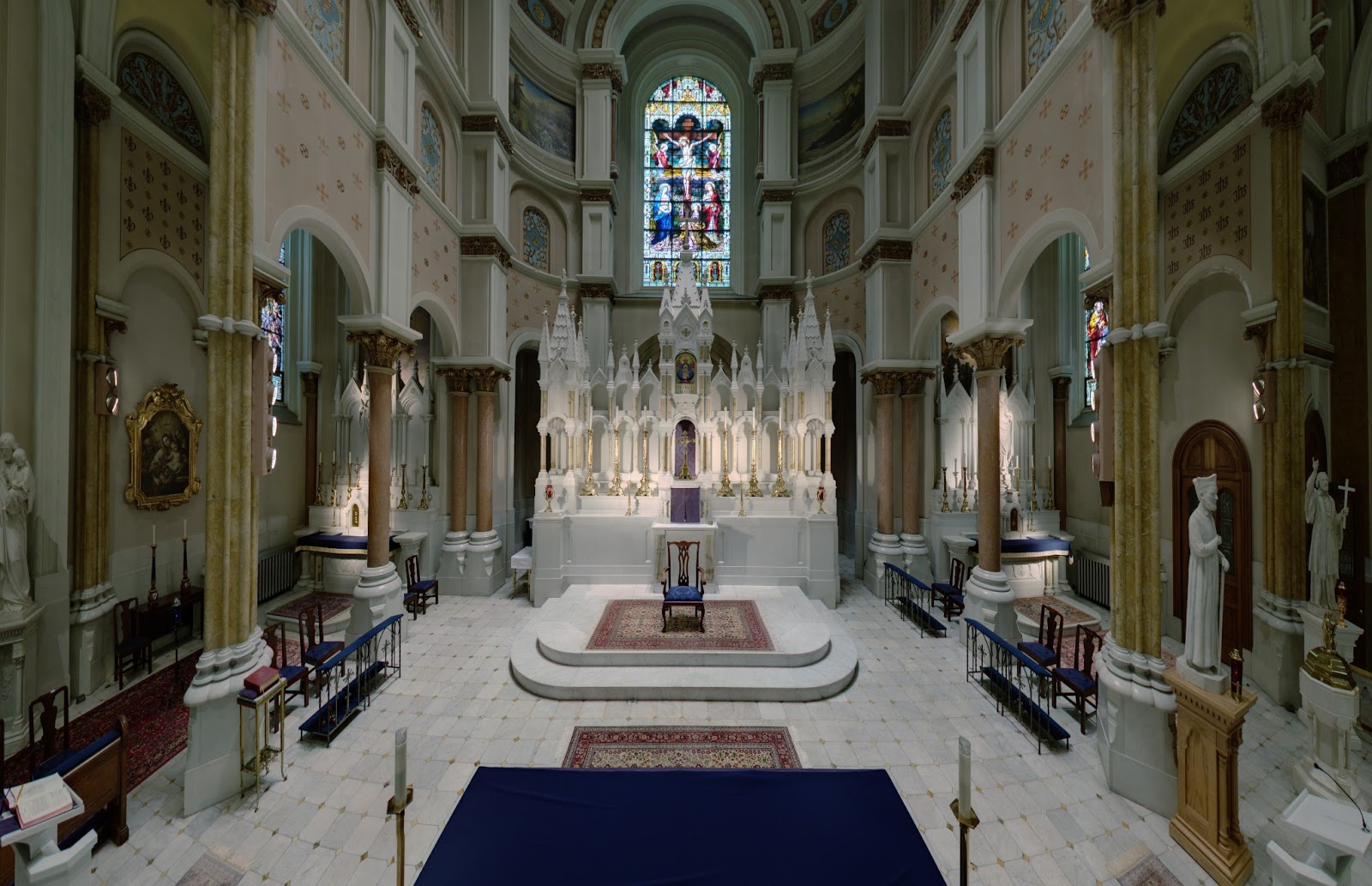
Interior of Old Church
NOTE: Joseph & Charlotte took their wedding vows here
"Saint Francis Xavier Parish in Philadelphia, Pennsylvania was founded in the year of Our Lord One Thousand Eight Hundred Thirty Nine. At the time of its establishment the diocese of Philadelphia was only a little more than three decades old and included all of Pennsylvania, western New Jersey and the state of Delaware.

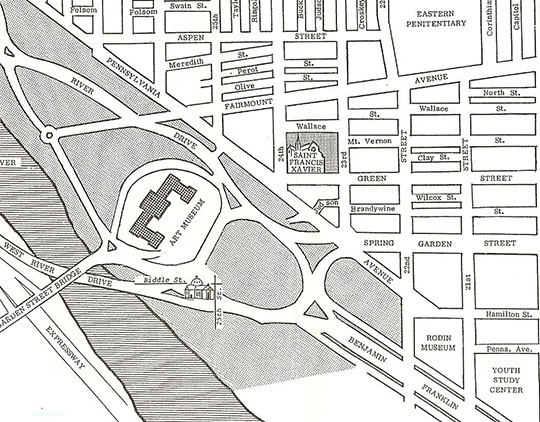
The new Saint Francis Xavier Church was only the seventh Catholic Church to exist within the city. The site purchased for the new church was at the southwest corner of 25th and Biddle streets -- not far from the grand front steps of today's Philadelphia Museum of Art. The erection of the new church was directed by (the first Pastor of the parish) Father Michael O'Connor. At least part of the money used to build the church was raised by a city-wide collection. The cornerstone of the new church was laid on June 10, 1839. Mass was celebrated there for the first time on Sunday, December 1, 1839.

Portrait of Rev. Patrick Rafferty
Philadelphia, Pennsylvania
In 1842, Father Patrick Rafferty was appointed pastor of Saint Francis Xavier Parish. Father Rafferty took up residence in a small house at 402 North 25th Street, very near to the church. In 1844, during the anti-Catholic unrest which afflicted the United States, two Catholic churches and the homes of thirty Catholics were destroyed by fire in Philadelphia. Because of the unrest, by order of Bishop Kenrick, on Sunday, May 12, 1844, Catholic churches in the city were closed. Various accounts of the parish history indicate, however, that in spite of that situation, Mass was celebrated by Father Rafferty in our church on that day. During the month which followed, the church was guarded day and night by militia sent by the civil authorities, and by a number of parishioners who volunteered their services.

In 1845, Father Rafferty opened Saint Francis Xavier School in the basement of the church. Father Rafferty died in March of 1863.

Father James Maginn was appointed pastor of Saint Francis Xavier Parish in 1863. Prior to being appointed Pastor he had served for eight years as an assistant to Father Rafferty, and for a brief period after Father Rafferty's death he served as Administrator of the parish. Almost immediately upon his appointment as pastor, Father Maginn began to make improvements to the parish property. He had erected a new rectory just south of the church; he added transepts, stained glass windows and a dome to the church. He also enlarged the galleries of the building. In spite of all the improvements, it soon became obvious that the rapidly expanding parish was outgrowing its church, and especially, its school. In the late 1860's Father Maginn had constructed a three story brick school building at the southeast corner of 24th and Green streets. He also purchased two adjoining houses which would eventually become the first Saint Francis Xavier Parish convent for the Sisters, Servants of the Immaculate Heart of Mary (IHM).
Map of second church location
[CLICK TO ENLARGE]

The idea of a new church became imperative when the Baltimore and Ohio Railroad decided to change the grade of its track which ran near the church at Biddle Street. Because tunneling was involved in the project, the blasting of rock was necessary. That process resulted in significant damage to both the church and the adjacent rectory. Father Maginn then purchased the land at 2321 Green Street, where he constructed a rectory (this building is now the residence of our Oratory of Saint Phillip Neri community). As soon as the rectory was completed, Father Maginn began to negotiate the purchase of property to the west of the new building. That site would be the site of our present church. Father Maginn had secured three of the four properties needed when he suddenly became ill. On July 25, 1890, Father Maginn died at the new rectory.

Immediately after the death of Father Maginn, Reverend Michael Gleeson was appointed pastor of Saint Francis Xavier Parish. Father Gleeson wasted no time in taking up the work of constructing a new church. The purchase of the final ground needed was completed by 1894; the ground was cleared and the digging of the new church's foundations began that same year. On October 6, 1894, the corner-stone of the new church was laid by Archbishop Ryan. On December 18, 1898, the now completed church was dedicated by Archbishop Ryan and a Pontifical Mass was celebrated by Bishop Prendergast. At just about the time of the church's dedication, Father Gleeson was afflicted with a form of paralysis that was finally to cause his death on January 25, 1904, after a long, painful illness. In March of 1904, Father Thomas F. Shannon was appointed the sixth pastor of Saint Francis Xavier Parish.

St. Francis Xavier Catholic Church
(current church - built 1898)

It would be Father Shannon's task to rally the parish in one of its most difficult moments. On March 31, 1906, a building then located at 24th and Wallace streets caught fire and was completely destroyed. During that event the fire managed to leap to the newly opened church at Green Street and it too was severely damaged. The roof of the church was completely destroyed, and a great deal of damage was done to the interior when the roof fell. [See newspaper story of church fire below.]

Almost immediately after the fire, reconstruction of the church began. A temporary alter was erected in the school on Green Street and Mass was celebrated there until the Church reopened on April 5, 1908. The cost of the reconstruction had been one-hundred thousand dollars."

To get a complete 360 degree view - top to bottom - of the present church please go to http://www.360cities.net/image/stfrancisxavierchurchphladelphia#-155.88,-10.07,69.6 at 360cities website. It is simply awesome. The church is described here: "St. Francis Xavier is a striking asymmetric Romanesque church at 24th and Green Streets near the Benjamin Franklin Parkway in the Fairmount section of Philadelphia.  It was originally built in 1893-1898 to designs by architect Edward Durang, extended to its present size in 1906, and rebuilt in 1908 after being damaged by a fire that started in a nearby hat factory.  Unlike many Catholic churches, it did not modify its old High Altar following the liturgical reforms of Vatican II in 1962."

St. Francis Xavier - The Oratory
Fire Ruins Beautiful St. Francis' Church
[from The Philadelphia Inquirer; April 1, 1908; page 1-2]
Priests Risked Lives Saving Valuable Contents of Roman Catholic edifice That Ignited From Hat Factory Blaze

    "The beautiful interior of the Roman Catholic Church of St. Francis Xavier, at Twenty-fourth and Green streets was swept by a spectacular fire yesterday afternoon that originated in the hat factory of Henry Roelofs & Co. adjoining the rear of the edifice.
     When the firemen, after a hard battle of nearly three hours, finally had the flames under control, only the walls and the steeple of the church remained standing, the hat factory had been destroyed, and several residences nearby had been badly damaged. The total loss was estimated at $150,000. 
[CLICK TO ENLARGE]

    The fire was replete with sensational incidents. Again and again the firemen bravely risked their lives in their efforts to subdue the flames, scaling the burning and treacherous roof of the church with lines of hose, dodging falling masses of debris and narrowly escaping being buried beneath toppling walls. Three of them were badly bruised and cut as one of the walls of the hat factory fell. They were taken to the German Hospital. They were Asst. Fire Chief Waters, Charles H. Porter, Jr., assistant foreman, and Robert McClellan, both of Engine Company No. 4, Seventh and Sansom streets. Other firemen received various minor injuries, but all refused to leave their posts while there was danger of the flames spreading eastward to the residences on Green street.
     Remarkable courage was shown by Rev. John J. Fleming, acting rector of the church aided in carrying many objects ices, vestments and other articles of value that were in the sacristy or on the altar when the church caught fire. Rev. Mr. Fleming risked his life by running into the smoke-filled edifice and bearing away from the altar the Blessed Sacrament. Many of the men parishioners of the church aided in carrying many objects of value from the burning structure until the quickly spreading flames made further efforts of that sort too hazardous.
     The fire started at the storehouse of the factory of Henry Roelofs & Company, 609-19 North Twenty-fourth street. There were fifty men at work in the factory at the time, all of whom got safely out.
     The flames spread throughout the factory with remarkable swiftness. The south wall of the two-story brick structure was but three feet from the rear of the church in which were five large stain glass windows overlooking the sacristy. These glass in these windows were shattered by heat of the flames that rose from the burning factory. The wind was blowing toward the windows and through them the flames swept into the church. In vain did the firemen try to save the church, an immense granite pile upon a high terrace.
     The wind fanned the flames and they swept along the walls of the church and up through the slate roof. From the top of nearby house the firemen poured streams of water upon the burning structure, but the wind was so strong that at one time grave fears were entertained for the safety of the immediate neighborhood....

Page 2
[CLICK TO ENLARGE]
    As great tongues of flames shot through the roof of the church , above which rolled great clouds of smoke, the rays of the setting sun seemed to intensify the glare. Now and then the bells of the church steeple, probably as a result of the vibration of the walls or of water descending upon them, would peel forth melancholy notes with weird effect.
     Although the interior of the church was wrecked a large crucifix over the altar and one or two effigies of saints remained unbroken. The $6000 organ was ruined while several pains were broken in the circular stain glass window in the front of the church, which was a gift of Archbishop Ryan...."


Monday, July 15, 2013

MONDAY'S MOTHER - Louisa Elizabeth Waetcher Horst (1838-1933)

Louisa Waetcher Horst
ca. 1900
Louisa Elizabeth Waetcher was born September 14, 1838, in Schildesche, Bielefeld, Westfalan, Prussia, a town that was formed in the year 939. [Schildesche is now a part of North Rhine-Westphalia in Germany]. Her parents were Johann Frederich Waetcher (1807-1883) and Anna Catherina Illsibien Horenberg (1813-UNK). Louisa had a twin sister, Hanne Friederieke. They are two of the ten siblings that immigrated with their father and step-mother, Hanne Friederiecke Luise Hartman, to the United States, arriving on November 9, 1852, in the Port of New Orleans. Louisa was just 14 years old. [NOTE: Louisa's step-mother gave birth while on the ship.]

The Waetcher family settled in Massac County, Illinois. On October 19, 1856, Louisa married Charles Horst (1836-1900), an immigrant from Hesse-Darmstadt, Germany. She just turned 18; Charles was 21. Charles was the youngest brother of Martin Horst (1830-1878), my 3x-great-grandfather. Charles, who changed his name from Carl after arriving in America, had arrived with his father and siblings and step-mother in August 1846 when he was just 11.

Charles and Louisa Horst are my 4x-great-aunt and uncle.

Charles and Louisa set up their home in Metropolis in Massac County. Charles was working in 1860 as a Cabinet Maker. After the Civil War was over he wrote his brother Martin, now living in Mobile, Alabama, to ask for a loan to help him purchase a mill in Metropolis. Martin wasn't able to help him at this time but by 1870 Charles listed his occupation as a "Flour Miller" according to the U.S. Census. He remained a miller throughout his lifetime.

Charles and Louisa had their first of twelve children in early 1856. [NOTE: This date is before the known date of their marriage but this may be an error in the transcription of the old records.] Over the next 26 years Louisa would give birth to eight more daughters and two sons; the name and sex of their twelfth child is not known. Their children were:
  • Kunigunde Elizabeth Horst (female), called Gundy, was born in March 1856. She married Frederick William Rieke (1854-1922) in 1880. Together they had five children: Gertrude Augusta (1881-1970); twins Bertha Wilhelmina (1883-1953) and Maude L. (1883-1963); Charles Grover (1885-1969); and Romona (1890-1986).
  • Bell Horst (female) was born in 1858. She died before 1880.
  • Tell Horst (male) was born January 28, 1861. He died before 1880.
  • Eleanora Horst was born 1866. She died before 1880.
  • Fannie Caroline Horst, born March 1869. She married George Mehaffey (1864-1957) in 1901. Fannie died during childbirth, giving birth to twins Francis Carl Mehaffey (1908-2003) and George James Mehaffey (1908-1994). [NOTE: older sister Gundy helped care for the infants boys for a time immediately after their birth.]
  • Twin Nellie Horst was born in 1871. She died before 1880.
  • Twin Nettie Horst was born in 1871. She died before 1895.
  • Lillie Dale Horst was born January 1, 1875. She married Morton Burnette Card (1878-1950) in 1914. They had one daughter, Flora Louise Card (1914-1996). Lillie died January 20, 1972.
    Cassie Horst
    ca. 1900
  • Twin Callie Emma Horst was born August 16, 1877. Callie never married; she died March 11, 1964.
  • Twin Cassie Anna Horst married Elwin Arba Magill (1874-1947) in 1902. They had two children Calina Magill (1903-1989) and Elwin Arba Magill, Jr. (1914-2001). Cassie died June 10, 1956. 
  • Walter Earnest Horst was born July 12, 1882. In 1910 he married Anna J. Murray (1880-1953). Walter died November 1, 1959. They had no children.
Callie Horst
ca. 1900

Louisa's twin sister, Rieke, as she was called, also had twelve children with her husband William Frederick Rixie (1836-1888).

In 1895, Charles and Louisa left Illinois with their surviving children and moved to Pomona, in Los Angeles County, California. Charles died in 1900. Louisa lived with her unmarried children in Pomona, supported by their various incomes. One by one they married and moved away. All but daughter Callie. Callie worked as a Bookkeeper at a Laundry in town. Their last residence was at 678 Gordon Street in Pomona, which Louisa owned.

from Los Angeles Times
May 6, 1933; page A-6
On May 5, 1933, Louisa died in her home. She was 94 years old. She is buried at Pomona Cemetery.

In her 94 years Louisa had lived quite a lifetime.  Born in Prussia, she lost her mother as a young girl. She traveled to America at the age of 14, in steerage class. Speaking only German she settled with her family in the town of Metropolis, Illinois. She married at the age of eighteen and bore twelve children over twenty-six years. She was the wife of a flour mill owner. She buried four young children while living in Illinois. At the age of 56 she packed up her home and her family and traveled across country by train to California before the turn of the century. She left behind her home of forty-three years, her friends, and her family - including her twin sister.

In California she lost her husband of forty-four years and saw at least four of her children marry, leave home and have children of their own. She buried four more of her children before she herself died. She was survived by four children, ten grandchildren and at least thirteen great-grandchildren. What kind of mother was she? I don't know for sure, but there's no doubt that she was a hardworking mother, a supportive wife and a woman devoted to the well-being of her family.

TWINS MUST RUN IN THE FAMILY: Louisa was born a twin (1838). She gave birth to two sets of twins, in 1871 and 1877. Her oldest daughter gave birth to one set of twins in 1883, and another daughter died giving birth to her own set of twins in 1908. In a time when there were no fertility specialists, this is quite a legacy.

Thursday, July 4, 2013

THURSDAY'S TREASURES - Life, Liberty and the Pursuit of Happiness

On this, the 237th birthday of the United States of America, it seems the perfect time to celebrate not only our country's birth but also the gifts that were passed down to us from our ancestors who made it possible for us to celebrate as Americans.

Irish Immigrants Leaving Queenstown Harbour
The Illustrated London News, September 1874

For each of us there were great-grandfathers and great-grandmothers who left their homeland, their neighbors, the culture and very often their own families to take a chance in this new country of which they knew very little. They gathered up all they could carry with them, said good-bye to their friends and families, and left the only home they had ever known and most likely one they would never return to. They travelled by cart or by foot to a sea port where they would board a small packet ship. Once aboard they would climb down into the hull of the vessel with one hundred, two hundred, or more strangers to travel for several weeks across the Atlantic Ocean. With all of the multitude of people stuffed into the ship's steerage area [see post "Packet Ship Gladiator", January 1, 2012,  for more information about steerage] they all shared one common dream - a better life in America.

Many left behind poverty, with little chance to ever change their circumstances. Most left countries with governments that held a tight rein on their individual rights and freedoms. Towns where they weren't allowed to speak, or protest, or gather freely. Where they couldn't vote to choose their own leaders. Where their children faced forced conscription into the military. Where the right to practice the religion of their own choosing didn't exist.


"Irish Immigrants Leaving Home"
Harper's Bazaar, December 1870
They each knew that a better life existed - for themselves and for their children. And for their children's children. They wanted more for their life and for their family. They wanted to be free to choose their own path in life, and be treated as human beings with God-given rights. They wanted to work hard and be rewarded with just compensation. They wanted to have a say in their government and in the laws they lived under. They wanted to freely practice their faith. They wanted the freedom to have a dissenting opinion about their leaders, share it openly, without the fear of reprisals. They wanted this for themselves. But most of all they wanted this for their children.

"From the Old to the New World"
German Emigration
Harper's Weekly, November 1874
They left everything behind for a promise of a better life. They sailed on a ship across a wide ocean, not knowing if they or their family members would survive, or if the ship itself would make it safely. They landed in a port where they couldn't speak the language, maybe had no one waiting for them, had little direction on where to go or what to do next. But they paved the way for each one of their children, each one of their grandchildren - each one of us - to enjoy those unalienable rights we each possess, endowed for us by our Creator.

Among these - Life, Liberty and the Pursuit of Happiness.

America wasn't perfect then and it isn't perfect now. But it's the best there is. And we have our ancestors to thank for giving us the opportunity for a better future. So it's nice today to remember those that made it possible:

Patrick McCloskey (1810-1855) who arrived in Philadelphia, Pennsylvania in 1838, at the age of 28, from his home in Ireland. His wife Mary Ann (1805-1871) also immigrated from Ireland, date unknown. They are my 4x great-grandparents.

Thomas McCaffrey (1799-1890), arrived in New York Harbor in June 1825 from his home in County Tyrone, Ireland. His wife Susan (1793-1869) also immigrated from County Tyrone, date unknown. They, too, are my 4x-great-grandparents.

Johann Eckard Horst (1802-1852), my 4x-great-grandfather, arrived in August 1846 in New York City Harbor at the age of 43 with his second wife and five children. This included my 3x-great-grandfather Martin Horst (1830-1878), who was just 16 years old when he arrived. Later my 5x-great-grandfather Johan Conrad Horst (1780-UNK), Martin's grandfather, also arrived here, in May 1860. He was 80 years old when he arrived. They were from Hesse-Darmstadt, Germany.

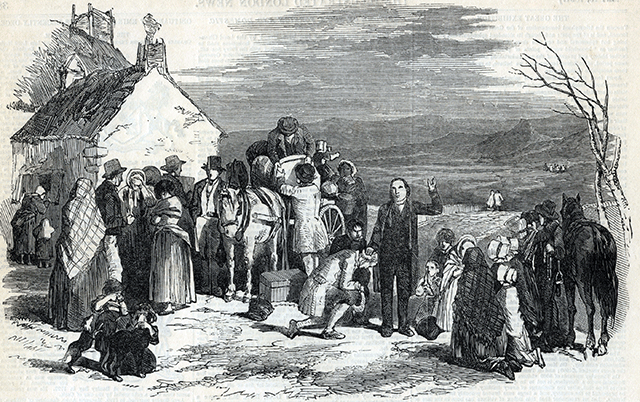
"Irish Emigrants Leaving Home - The Priest's Blessing"
The Illustrated London News, May 1851

Apollonia Weinschenk (1829-1908), my 3x-great-grandmother and wife of Martin Horst, arrived in the port of New Orleans around 1843, at the age of 14, from her home in Forst, Bavaria, Germany.

 My great-great-grandfather Patrick O'Donnell (1823-1911) arrived in this country in December 1849 from Ireland, along with five of his 7 brothers. He was 26 years old. His wife Bridget Kennedy (1838-1893) immigrated from her home in  County Tipperary, Ireland, sometime in the early 1850's.

Phillip Huber (1847-1901), also my great-great-grandfather, arrived in New York in June 1867, at the age of 19, from Florsheim, Hessen, Germany.

My 3x-great-grandparents, John Michael Baptiste Brunett (1818-1863), and Barbara Frisse (1822-1893) traveled onboard the same ship, from their homes in Seingbouse, Moselle, France, arriving in the port of New Orleans in July 1846. Traveling with Barbara were her parents (my 4x-great-grandparents) Joseph Frise (1796-1864) and Marguerite Lang (1802-1868), as well as several siblings. Marguerite was 44 years old; Joseph was 50.

[NOTE: My Fortier and DeGruey ancestors arrived from France to Canada and then settled in Louisiana before the United States was formed. I have no information yet as to when my Flemming or Jackson family ancestors arrived in America.]

"Immigrants Behold the Statue of Liberty"
Frank Leslie's Illustrated Newspaper, July 1887
None of these ancestors arrived as we might imagine - coming into New York Harbor and seeing the Statue of Liberty, stepping off their steamship onto Ellis Island to be officially inspected in long lines. [The Statue of Liberty wasn't dedicated until 1886.] None of these ancestors settled on the east coast - most made their new homes in southern cities. And somehow, through happenstance or through fate, their offspring met other offspring of these immigrants and eventually, over time and over years, my mother and her siblings were created from a combination of all of these immigrants. And that made it possible for me to sit down, in my home in Birmingham, Alabama, and celebrate Independence Day and my great-grandparents' dreams for a better life.

Thursday, June 13, 2013

THURSDAY'S TREASURE - Grandmom's Earbobs

One Pair of Grandmom's Earbobs
Treasures can come in all shapes and sizes. The Merriam-Webster Online Dictionary defines a treasure as follows: "(1) wealth of any kind or in any form; (2) something of great worth or value; also : a person esteemed as rare or precious; (3) a collection of precious things." I know that throughout my large extended family there are treasures of great monetary value, treasures passed on through generations and treasurers with great stories behind them. The treasure that I want to share today doesn't fit any of these descriptions. But they are precious and of great worth to me - my grandmother's earbobs.

Susie Flemming O'Donnell
wearing a pair of earbobs - 1992
Susan Elizabeth Flemming O'Donnell (1909-1999) was hoot. She told me at one of my bridal showers in 1990 that she was always invited to parties throughout her life "because she was cheaper than hiring a clown." She was the mother of eight children and the grandmother of twenty. At the time of her death she also had nineteen great-grandchildren. She had been married to the love of her life, John Huber O'Donnell (1905-1964), and was widowed when she was just 54. Her faith and her family kept her going, and she lived 35 years longer as the matriarch of my mother's family.

She was a southern lady - born and bred in Birmingham, Alabama - a product of her times. But she was also a rare, one-of-a-kind treasure to her family, friends and all who had the unique pleasure to meet her. This post can't begin to do her the justice that her life and legacy deserve. So I won't attempt. But I can share these little treasurers that I was able to pick out - after all her other treasurers were chosen - from items that my mother got after her death. These treasures are Grandmom's "earbobs".

Grandmom, as we grandchildren call her, enjoyed dressing up to go out to lunch or dinner with family and friends. She always wore a necklace or a pin, maybe a bracelet or two, with her dress - pants or slacks were not a part of her public attire. Along with her various accoutrements she always wore "earbobs".  They were clip-on earrings, usually quite large and round, and mostly not of any great monetary value.
Earbobs with Matching Pin
She seemed to have dozens of pairs to choose from. I remember as a little girl going off to her bedroom while the adults talked in the living room, and looking in her jewelry box, full of all colors and styles of jewelry. I don't remember picking anything up or trying anything on, but I probably did. Her things were bigger and bolder than the styles my mother had at home in her jewelry case. My Mom seldom wore earrings - and never wore "earbobs". So Grandmom's treasures were unique unto her.

I tried to find the origin of the term "earbob". I couldn't find when or where the word originated, but I found numerous historical museums that had "earbobs" from native Americans in their collections. I found the term used in 19th century literature, as well as in more modern books. Many fans of the movie Gone with the Wind will remember Scarlett O'Hara offering her "earbobs" to Rhett Butler for collateral for a loan (he declined). The use of the word "earbobs" continued, mostly in the South, but the word is seldom heard anymore.

But I can't look at these inexpensive clip-on earrings that I chose as a keepsake from my grandmother without remembering the giggles from me and my sisters and cousins when Grandmom made any mention of her "earbobs". We thought it was so silly a word then. Now I see the word, and the earrings - and, of course, my grandmother - all as wonderful, precious treasures.

QUESTION - Do you remember Grandmom's earbobs? Or your own grandmother's earbobs? Add your memory (or comment) below to share.